
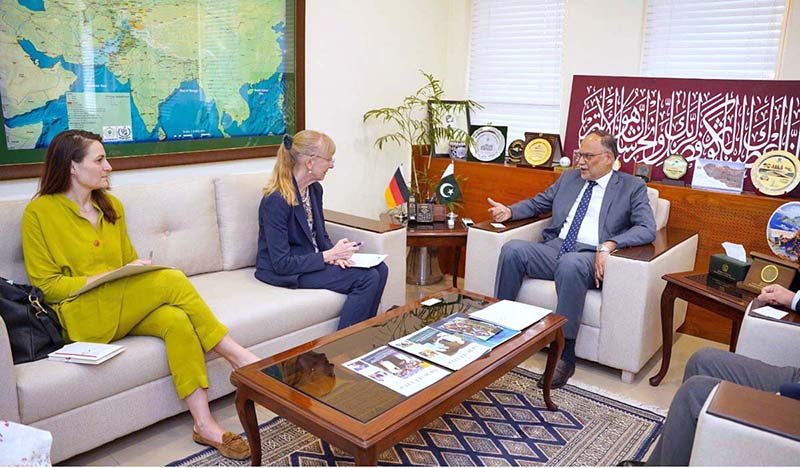
ISLAMABAD — Federal Minister for Planning, Development and Special Initiatives Ahsan Iqbal met with Ina Lepel, Ambassador of the Federal Republic of Germany to Pakistan, at the Ministry of Planning, Development and Special Initiatives on Monday. The courtesy call aimed to strengthen bilateral relations and discuss potential cooperation between Pakistan and Germany.
Discussion Points
During the meeting, Minister Ahsan Iqbal and Ambassador Ina Lepel explored several aspects of Pakistan-Germany relations. They focused on development projects and initiatives that could benefit both nations.
The conversation included potential collaborations in:
- Renewable energy
- Infrastructure development
- Vocational training
Minister Iqbal emphasized the wealth of experience Germany possesses in renewable energy as a global leader.
Ambassador Lepel expressed Germany’s interest in supporting Pakistan’s development agenda. She highlighted ongoing projects in Pakistan and indicated Germany’s eagerness to expand its role in the development sector, particularly in sustainable growth and economic stability.
Educational and Technical Training Programs
The meeting also addressed the importance of educational exchanges and technical training. Minister Iqbal pointed out the need to enhance the skills of Pakistan’s workforce to meet modern industry demands. He suggested that Germany could provide crucial technical assistance and training programs.
Both parties acknowledged the longstanding diplomatic ties between Pakistan and Germany, reiterating their commitment to further strengthen these relations through dialogue and cooperation.
Historical Context
Pakistan and Germany have maintained diplomatic relations since the early 1950s. Germany was among the first to recognize Pakistan’s independence. Over decades, both countries collaborated on various fronts like trade, education, and development aid.
Germany is one of Pakistan’s largest trading partners in the EU, with numerous German companies contributing to the local economy. Recently, Germany has been active in supporting Pakistan’s development, notably in renewable energy and vocational training. Through GIZ, Germany has engaged in projects improving energy efficiency and promoting sustainable development in Pakistan.
Significance of the Meeting
This meeting between Minister Ahsan Iqbal and Ambassador Ina Lepel is vital as it highlights the commitment of both nations to enhance cooperation. Germany’s support is crucial for sectors like renewable energy and vocational training to achieve sustainable economic growth in Pakistan.
Strengthening ties with Germany can lead to increased foreign investment in Pakistan, creating jobs, boosting economic activity, and improving living standards for citizens. Politically, the meeting reinforces Pakistan’s relations with a key EU member. In light of global challenges like climate change and economic instability, partnerships with Germany can help Pakistan navigate these obstacles effectively.














