
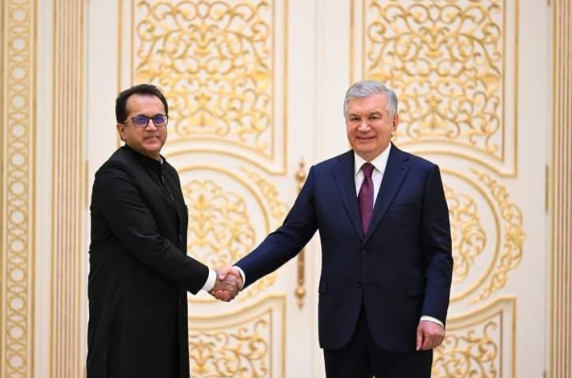
ISLAMABAD — Ambassador Muddasir on Tuesday presented his credentials to the President of Uzbekistan, Shavkat Mirziyoyev, reaffirming Pakistan’s commitment to enhancing bilateral relations. The ceremony took place in Tashkent, where the ambassador emphasized the importance of expanding cooperation in trade, tourism, and regional connectivity.
What Happened
In a formal ceremony held in Tashkent, Ambassador Muddasir officially assumed his diplomatic role by presenting his credentials to President Shavkat Mirziyoyev. This event marks a significant step in reinforcing the diplomatic ties between Pakistan and Uzbekistan. Ambassador Muddasir expressed his enthusiasm for the role and highlighted his commitment to fostering stronger ties between the two nations.
Following the ceremony, Ambassador Muddasir took to social media to express his sentiments, stating, “Privileged to present my credentials to the President of Uzbekistan. Looking forward to reinforcing our bilateral ties in trade, tourism, and regional connectivity.” His statement underscores the areas of focus that both countries are keen to develop further.
The ambassador’s presentation of credentials is a customary diplomatic procedure that signifies the official start of his tenure. It also serves as a platform for discussing mutual interests and potential areas of cooperation. The meeting between Ambassador Muddasir and President Mirziyoyev was characterized by a mutual desire to strengthen diplomatic and economic relations.
Background
Pakistan and Uzbekistan have enjoyed cordial relations since the establishment of diplomatic ties in 1992. Over the years, both countries have engaged in various bilateral agreements and cooperative initiatives. The focus has often been on enhancing trade, cultural exchange, and regional security.
In recent years, there has been a renewed emphasis on regional connectivity, particularly through initiatives such as the China-Pakistan Economic Corridor (CPEC) and the development of the Trans-Afghan Railway project. These projects aim to improve trade routes and economic integration in Central and South Asia, with Uzbekistan being a key partner in these endeavors.
Uzbekistan’s strategic location and its rich cultural heritage make it an important partner for Pakistan in terms of trade and tourism. The two countries have been working on increasing people-to-people contacts and boosting tourism, which is seen as a vital area for economic growth.
Why It Matters
The strengthening of ties between Pakistan and Uzbekistan holds significant implications for both countries and the broader region. Economically, enhanced trade relations can lead to increased market access and investment opportunities. Uzbekistan’s burgeoning economy and its role as a transit hub in Central Asia present numerous opportunities for Pakistani businesses.
Politically, the partnership can contribute to regional stability and security. Both nations share common interests in combating extremism and fostering peace in Afghanistan, which is crucial for regional prosperity. Enhanced cooperation can also lead to more effective collaboration in international forums, strengthening their collective voice on global issues.
Socially, increased tourism and cultural exchanges can lead to a deeper understanding and appreciation of each other’s heritage, fostering goodwill and mutual respect. These exchanges can also stimulate economic activity in sectors such as hospitality and services, contributing to job creation and economic diversification.
On an international level, the collaboration between Pakistan and Uzbekistan can serve as a model for regional cooperation, demonstrating the benefits of diplomatic engagement and economic partnership in addressing common challenges.
Key Takeaways
- Ambassador Muddasir presented his credentials to Uzbek President Shavkat Mirziyoyev, marking the start of his diplomatic tenure.
- The focus of Pakistan-Uzbekistan relations includes trade, tourism, and regional connectivity.
- Both countries have a history of cooperation since establishing diplomatic ties in 1992.
- Enhanced relations can contribute to regional stability, economic growth, and cultural exchange.
- The partnership holds potential benefits for regional trade routes and international collaboration.
Source Attribution
This article is based on official government statements, press releases, and public communications from relevant authorities.














