
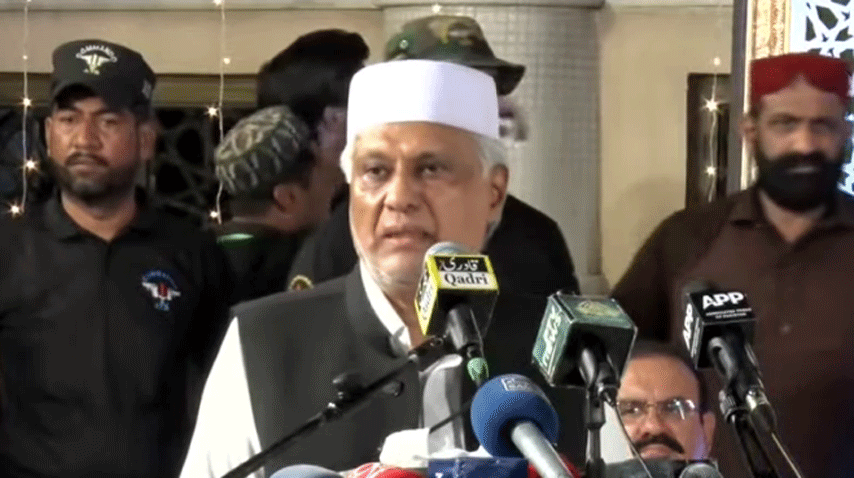
ISLAMABAD — Deputy Prime Minister and Foreign Minister Muhammad Ishaq Dar announced on Friday that the second phase of the Bari Imam shrine extension will commence shortly, with ongoing work on the third phase of the Data Darbar project. The announcement was made during the inaugural ceremony of the three-day annual Urs of Hazrat Shah Abdul Latif Kazmi, known as Bari Imam.
What Happened
Deputy Prime Minister Muhammad Ishaq Dar revealed plans for the second phase of the Bari Imam shrine’s extension during a ceremony marking the annual Urs of Hazrat Bari Imam. The event, held in Islamabad, was attended by federal ministers and members of Parliament. Dar highlighted that the first phase of the shrine’s extension was completed under a previous government led by the Pakistan Muslim League (Nawaz) (PML-N), and the current administration remains committed to furthering this expansion.
Dar’s visit to the shrine included laying a chadar and wreath, along with offering prayers for the nation’s security, progress, and prosperity. The Urs, a significant religious event, is being held for the first time in 16 years, thanks to the efforts of the PML-N leadership, particularly former Prime Minister Nawaz Sharif. The Urs is scheduled to take place from August 15 to 17, drawing devotees from across the country.
In his address, Dar emphasized the historical role of Ulema and Sufis in spreading Islam in the region, which eventually contributed to the creation of Pakistan under the leadership of Quaid-e-Azam Muhammad Ali Jinnah and other founding figures. He also remarked on Pakistan’s special connection with Madina, underscoring the country’s enduring existence as a ‘land of the pure.’
Background
The Bari Imam shrine, located in Islamabad, is a revered site dedicated to Hazrat Shah Abdul Latif Kazmi, a prominent Sufi saint. The shrine has been a focal point for spiritual gatherings and religious events. The first phase of its extension was completed under the PML-N government, reflecting the party’s commitment to preserving and enhancing the country’s spiritual heritage.
The Data Darbar in Lahore, another significant Sufi shrine, is currently undergoing its third phase of development. Both projects highlight the government’s focus on maintaining and expanding religious sites that hold cultural and historical significance for Pakistan’s Muslim majority.
Why It Matters
The expansion of the Bari Imam shrine is significant for several reasons. Firstly, it underscores the government’s dedication to preserving and promoting Pakistan’s rich Sufi heritage, which plays a crucial role in the country’s cultural and religious identity. The shrine attracts thousands of pilgrims annually, contributing to religious tourism and local economic activity.
Moreover, the government’s involvement in such projects reflects an effort to strengthen ties with religious communities and promote national unity through shared cultural and spiritual values. The revival of the Urs after a 16-year hiatus is particularly noteworthy, as it signifies a renewed commitment to religious traditions that have shaped the nation’s history.
On a broader scale, these developments can enhance Pakistan’s image as a country that values its spiritual and cultural heritage, potentially attracting international visitors and fostering a deeper understanding of the nation’s historical context. The government’s focus on religious sites also aligns with efforts to promote peace and tolerance, countering narratives of extremism that have affected the region.
Key Takeaways
- The second phase of the Bari Imam shrine extension is set to begin soon, as announced by Deputy Prime Minister Muhammad Ishaq Dar.
- The Urs of Hazrat Bari Imam, held after 16 years, will take place from August 15 to 17.
- The government is committed to preserving and expanding Pakistan’s Sufi heritage through projects like the Bari Imam and Data Darbar shrine extensions.
- The initiatives aim to boost religious tourism and promote national unity through shared cultural and spiritual values.
- These developments contribute to enhancing Pakistan’s image as a country that values its spiritual and cultural heritage.
Source Attribution
This article is based on official government statements, press releases, and public communications from relevant authorities.














