
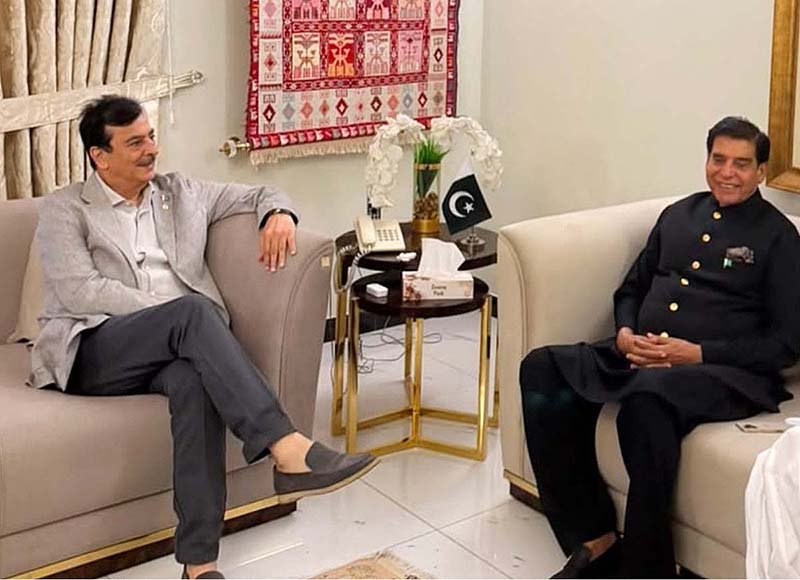
ISLAMABAD — Chairman Senate Syed Yousaf Raza Gilani held a meeting with former Prime Minister and senior Pakistan People’s Party (PPP) leader Raja Pervaiz Ashraf at the chairman’s residence in Islamabad. The meeting, which took place on Wednesday, was an opportunity for the two seasoned politicians to exchange views on the current political landscape and discuss future strategies for the party.
What Happened
The meeting between Chairman Senate Syed Yousaf Raza Gilani and Raja Pervaiz Ashraf was a significant gathering of two influential figures within the Pakistan People’s Party. According to sources close to the meeting, the discussions centered around the political challenges facing the PPP and the broader political climate in Pakistan. The meeting was described as cordial, with both leaders expressing their commitment to strengthening the party’s position in the national political arena.
During the discussions, Gilani and Ashraf reportedly deliberated on the upcoming general elections and the party’s strategy to enhance its electoral performance. They also addressed the importance of unity within the party ranks and the need to engage with the public on key issues affecting the nation. The meeting underscored the PPP’s focus on consolidating its support base and preparing for future political contests.
In a statement released after the meeting, Chairman Senate Gilani emphasized the importance of dialogue and cooperation among party leaders to address the challenges facing Pakistan. He stated, “Our party has always been at the forefront of advocating for democratic values and the welfare of the people. It is crucial that we work together to uphold these principles.”
Background
Syed Yousaf Raza Gilani, a veteran politician, has served as the Prime Minister of Pakistan from 2008 to 2012. He is a prominent member of the Pakistan People’s Party, which has been a major political force in the country since its founding in 1967. Raja Pervaiz Ashraf, who succeeded Gilani as Prime Minister in 2012, is also a key figure in the PPP and has held various ministerial positions during his political career.
The PPP has historically been one of Pakistan’s leading political parties, advocating for social justice, economic reforms, and democratic governance. However, in recent years, the party has faced challenges in maintaining its influence, particularly in the face of rising competition from other political entities such as the Pakistan Tehreek-e-Insaf (PTI) and the Pakistan Muslim League-Nawaz (PML-N).
Why It Matters
The meeting between Gilani and Ashraf is significant as it highlights the ongoing efforts within the PPP to regroup and strategize for future political engagements. As Pakistan approaches its next general elections, the PPP is keen to revitalize its image and reconnect with its traditional voter base. The discussions between these senior leaders are likely to shape the party’s approach in the coming months.
Politically, the PPP’s ability to present a united front and articulate a clear vision for the country’s future will be crucial in determining its electoral prospects. The party’s historical commitment to democratic principles and social welfare policies remains a central theme in its political narrative, and its leaders are working to ensure these values resonate with the electorate.
Economically, the PPP’s policies have often focused on addressing inequality and promoting inclusive growth. As Pakistan grapples with economic challenges, including inflation and unemployment, the party’s stance on economic reforms and social justice will be critical in appealing to voters seeking change.
Key Takeaways
- Chairman Senate Syed Yousaf Raza Gilani and former Prime Minister Raja Pervaiz Ashraf met to discuss PPP’s political strategy.
- The meeting focused on upcoming general elections and strengthening party unity.
- Both leaders emphasized the importance of dialogue and cooperation within the party.
- The PPP aims to revitalize its image and reconnect with its voter base ahead of elections.
- The party’s commitment to democratic values and social welfare remains central to its political agenda.
Source Attribution
This article is based on official government statements, press releases, and public communications from relevant authorities.














