
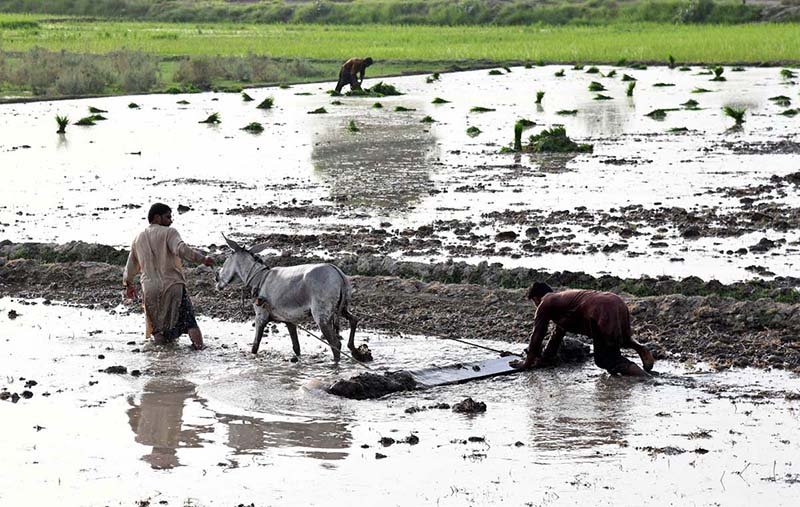
LARKANA — Farmers in Larkana are employing traditional agricultural techniques to prepare fields for rice cultivation as the monsoon season progresses. On August 3, local farmers were observed using wooden levelling slabs and donkeys to ready their fields, a practice that underscores the enduring reliance on age-old methods in Pakistan’s rural heartlands.
What Happened
In the rural areas of Larkana, a region known for its agricultural productivity, farmers are currently engaged in the critical phase of preparing their fields for rice cultivation. This involves the manual operation of wooden levelling slabs, which are pushed by hand to flatten the soil, and the use of donkeys to assist in this labor-intensive process. These methods, deeply rooted in tradition, remain prevalent due to their cost-effectiveness and the lack of access to modern machinery for many small-scale farmers.
The preparation of fields is a crucial step in rice farming, as it ensures that the soil is adequately levelled and ready to retain water, which is essential for rice growth. The use of donkeys to lead the levelling slabs is a testament to the farmers’ adaptation to available resources, balancing efficiency with economic constraints. This approach not only reflects the resilience of the agricultural community but also highlights the challenges faced by farmers in accessing modern agricultural technology.
Background
Rice is a staple crop in Pakistan, with the country being one of the largest producers and exporters of rice globally. The cultivation of rice is predominantly concentrated in the provinces of Punjab and Sindh, with Larkana being a significant contributor to Sindh’s rice output. The traditional methods employed by farmers in Larkana are reminiscent of practices that have been passed down through generations, illustrating a continuity of agricultural heritage.
Historically, the reliance on manual and animal-assisted farming techniques has been due to limited access to mechanized farming equipment. While some regions have seen advancements in agricultural technology, many rural areas continue to depend on traditional methods due to economic and infrastructural barriers.
Why It Matters
The persistence of traditional farming methods in Larkana has broader implications for Pakistan’s agricultural sector. Economically, the reliance on manual labor and animal power reflects the financial constraints faced by smallholder farmers, who constitute a significant portion of the agricultural workforce. This situation underscores the need for policy interventions that provide access to affordable technology and resources to enhance productivity and sustainability.
Socially, the use of traditional methods is indicative of the cultural heritage and knowledge systems that are integral to rural communities. However, it also highlights the disparities in technological adoption between urban and rural areas, which can impact the overall competitiveness of Pakistan’s agricultural exports.
On an international level, as global demand for rice continues to rise, the efficiency and sustainability of rice production in Pakistan are critical. Enhancing productivity through modern technology could significantly boost export potential and improve the livelihoods of farmers. Thus, addressing the technological divide is essential for aligning with global agricultural trends and ensuring food security.
Key Takeaways
- Farmers in Larkana are using traditional methods for rice field preparation, involving wooden levelling slabs and donkeys.
- The reliance on manual and animal-assisted techniques highlights economic constraints and limited access to modern machinery.
- Rice is a major crop in Pakistan, with significant production in Sindh, including Larkana.
- Addressing the technological divide in agriculture is crucial for enhancing productivity and export potential.
- Traditional methods reflect cultural heritage but also underscore the need for policy support in rural areas.
Source Attribution
This article is based on official government statements, press releases, and public communications from relevant authorities.














