
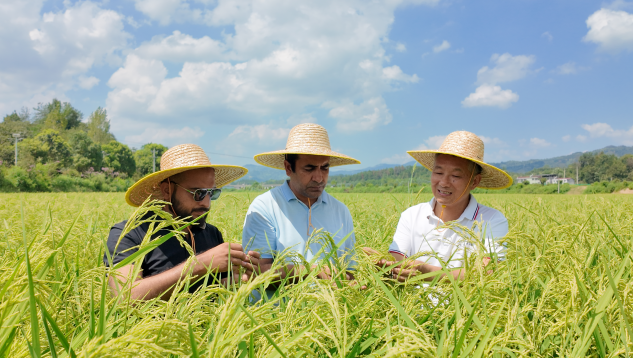
BEIJING — The 2nd International Symposium on Improved-Variety Breeding of Honglian Type Hybrid Rice was convened in Luotian, Hubei province, China, this week, spotlighting the collaborative efforts between Chinese and Pakistani experts in rice research. The event underscored the significant economic contributions of Honglian hybrid rice to Pakistani agriculture.
What Happened
The symposium, attended by agricultural professionals from both China and Pakistan, focused on the advancements in Honglian hybrid rice breeding, a notable achievement of the late academician Zhu Yingguo from Wuhan University. This hybrid rice is recognized as one of the world’s three major cytoplasmic male sterility systems, alongside China’s Wild Abortive type and Japan’s BT type. The Honglian hybrid rice is celebrated for its genetic traits, including heat tolerance, adaptability, and high grain quality, making it a popular choice in South China and Belt and Road countries like Pakistan, Malaysia, and the Philippines.
Qu Wenqian, Deputy Party Secretary of Wuhan University, highlighted that the Honglian hybrid rice has generated over RMB nine billion in direct economic benefits across China and its Belt and Road partners. Professor Zhu Renshan emphasized the importance of the Luotian base in ensuring seed security and supporting global food supplies. Dr. Muhammad Ashfaq from the University of the Punjab noted that approximately one-third of Pakistan’s rice cultivation is dedicated to coarse rice, which could see doubled production with the adoption of hybrid varieties. He stated, “With the adoption of Honglian Type hybrid rice, production will increase manifold, adding billions of rupees to the income of farmers and the economy of Pakistan.”
The symposium also highlighted the establishment of the Joint Research Center of Honglian Type Hybrid Rice by Wuhan University and the University of the Punjab in 2020. This collaboration led to the development of the Honglian hybrid rice variety HP4, which, after extensive trials across Pakistan, was registered as PU-786 in 2025. Following its national commercial approval, the variety was launched for commercial cultivation in 2026, praised for its resilience to heat, pests, and diseases, as well as its adaptability to local environmental challenges.
Background
The development of Honglian hybrid rice is part of a broader effort to enhance agricultural productivity and food security in regions facing climatic and environmental challenges. Hybrid rice technology, pioneered in China, has been instrumental in increasing rice yields and ensuring food security for millions. Pakistan, with its diverse climatic zones, offers a suitable environment for the cultivation of hybrid rice, which can significantly boost the country’s agricultural output.
Historically, Pakistan has relied heavily on traditional rice varieties, which are less resilient to environmental stressors. The introduction of hybrid rice varieties like Honglian offers a promising alternative, capable of withstanding adverse conditions while delivering higher yields. This shift aligns with global trends towards sustainable agriculture and food security.
Why It Matters
The adoption of Honglian hybrid rice in Pakistan is significant for several reasons. Economically, it promises to enhance the income of farmers by increasing rice yields and reducing losses due to pests and environmental stress. This, in turn, can contribute to the broader economic growth of Pakistan’s agricultural sector, a critical component of the national economy.
Socially, the increased rice production can improve food security, ensuring a stable supply of a staple food for the population. This is particularly important in a country where agriculture is a primary livelihood for a large portion of the population. The successful collaboration between Chinese and Pakistani institutions also exemplifies the potential of international partnerships in addressing global food security challenges.
Politically, the strengthening of ties between China and Pakistan through agricultural collaboration reinforces the strategic partnership between the two nations. It aligns with the objectives of the Belt and Road Initiative, fostering economic and technological exchanges that benefit both countries.
Key Takeaways
- The 2nd International Symposium on Honglian Hybrid Rice highlighted joint research achievements between China and Pakistan.
- Honglian hybrid rice offers significant economic benefits due to its adaptability and high yield potential.
- The variety has been officially registered and is commercially cultivated in Pakistan, enhancing food security and farmer income.
- This development underscores the importance of international collaboration in agricultural innovation.
- The initiative aligns with the Belt and Road Initiative, strengthening Sino-Pakistani relations.
Source Attribution
This article is based on official government statements, press releases, and public communications from relevant authorities.














