
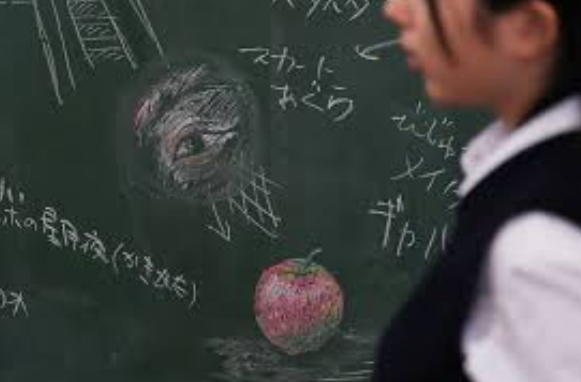
KUMAGAYA, Japan — Young Japanese artists are transforming traditional school blackboards into vibrant canvases, using colorful chalk to create intricate artworks. This unique form of expression is showcased in the annual national chalk art championship, known as ‘Kokuban Art Koshien’.
What Happened
The ‘Kokuban Art Koshien’, an annual event, invites high school students across Japan to participate in a chalk art competition, where the blackboard serves as the primary medium. The term ‘kokuban’ translates to ‘blackboard’ in Japanese, and the competition draws inspiration from the famed stadium where high school baseball is played. This year, around 300 high schools and junior high schools submitted entries, typically created during the summer break.
The artworks, often dreamlike and dazzling in their creativity, are collaborative efforts involving one or two students or sometimes entire groups. The themes range from dynamic depictions of dinosaurs, dogs, and whales to popular manga scenes and imaginative interpretations of everyday life, such as an underwater classroom. Some pieces even depict individuals writing on a blackboard, showcasing the medium’s versatility.
Kazunari Minamishima, an art teacher at Saitama Prefectural High School of the Arts, whose students have participated in the contest, noted that the medium allows for more experimental expression compared to traditional art forms like oil painting and sculpture. “It’s still a work in progress,” he commented, reflecting on the evolving nature of blackboard art.
The competition was initiated in 2015 by Nichigaku Co., a Tokyo-based blackboard manufacturer. Judging is conducted by examining photographs of the artworks, as the blackboards themselves are not easily transportable. Winners are announced in November. The concept of using blackboards for art was inspired by a stunning replica of Da Vinci’s ‘Last Supper’ discovered on a school blackboard, which caught the attention of Nichigaku’s President, Tomohiro Yoshida.
Background
The tradition of using blackboards as a medium for art has historical roots in Japan’s educational system. Initially, such creations were informal, often considered graffiti. However, the establishment of ‘Kokuban Art Koshien’ has formalized this practice, giving it a platform and recognition. The competition does not serve as a direct marketing tool for Nichigaku, as schools already possess blackboards, but it has helped some participants pursue careers as professional artists.
Techniques used in blackboard art include scattering chalk powder for a stardust effect and smudging with fingers and tissue paper to create shadows and muted tones. Some artists mix chalk powder with water, applying it in a style reminiscent of Jackson Pollock’s techniques. The ephemeral nature of the medium, which can be easily erased, reflects the orderly and conformist aspects of Japanese culture.
Why It Matters
This competition holds significant cultural and educational value. It provides a platform for students to engage in collaborative creativity, fostering teamwork and problem-solving skills. As the artworks are temporary, students learn to value the process over the permanence of their creations, which aligns with broader cultural themes of impermanence and renewal in Japanese society.
Economically, while the contest does not directly boost sales for Nichigaku, it enhances the company’s brand as a supporter of the arts and education. Socially, it encourages young people to explore artistic careers, contributing to the cultural richness of Japan. The potential for international expansion of the contest could further Japan’s cultural influence and promote cross-cultural artistic exchanges.
Key Takeaways
- The ‘Kokuban Art Koshien’ is a national chalk art competition for Japanese high school students.
- Blackboards serve as the canvas, allowing for experimental and collaborative artistic expression.
- The competition fosters creativity, teamwork, and problem-solving among participants.
- While not a direct marketing tool, it enhances Nichigaku’s brand and supports artistic careers.
- There is potential for the contest to expand internationally, promoting cultural exchange.
Source Attribution
This article is based on official statements and public communications from relevant authorities.














