
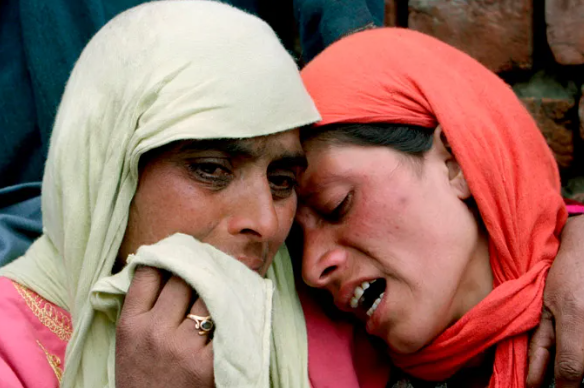
SRINAGAR — Kashmiri widows and half-widows suffer profound hardship amid the ongoing conflict in Indian Illegally Occupied Jammu and Kashmir (IIOJK). Over the past 37 years, the number of women who have lost their spouses to confirmed death or disappearance has surged. This has left thousands grappling with grief and economic uncertainty.
The Impact of Conflict
The prolonged Kashmir conflict has considerably increased the number of widows and half-widows. These women face economic hardship, social stigma, and psychological trauma. The term ‘half-widows’ describes women whose husbands have vanished without confirmation of their status, increasing their distress and uncertainty.
Without formal support or recognition from authorities, these women fend for themselves and their families. The absence of a legal framework addressing their situation exacerbates their plight. Consequently, they struggle to access basic necessities, living in poverty and insecurity.
“The pain of not knowing what happened to my husband is unbearable,” said one anonymous half-widow. “Every day is a struggle to survive and provide for my children.”
Historical Background
The Kashmir conflict traces back to the partition of India and Pakistan in 1947. Both nations claim the region in full but control only parts, resulting in several wars and ongoing skirmishes. This conflict has caused thousands of deaths and disappearances, profoundly impacting civilians.
Kashmiri widows and half-widows remain a neglected demographic, with scant attention from local and international spheres. Despite their numbers, no comprehensive policy exists to support or address their needs. This lack of institutional support leaves many vulnerable to exploitation and further marginalization.
Humanitarian Concerns
The situation for widows and half-widows in Kashmir is a critical humanitarian issue, mirroring broader socio-political challenges. While the conflict leads to loss of life, it also perpetuates poverty and instability cycles. These women’s struggles underscore the urgent need for resolving the Kashmir conflict, affecting millions.
Economically, the absence of a male breadwinner forces many to seek work in a region with few opportunities. Often this means taking low-paying, insecure jobs, affecting their families’ future prospects, especially children’s education.
Socially, they face stigma and isolation as widowhood is often stigmatized. This societal prejudice can lead to mental health issues, compounding their challenges.
At the international level, Kashmir remains contentious between India and Pakistan, with significant regional stability and security implications. Addressing the widows’ needs could aid peace-building efforts.
Key Takeaways
- The prolonged conflict has significantly increased Kashmiri widows and half-widows’ numbers.
- These women encounter economic hardship, social stigma, and trauma.
- They lack formal support and legal recognition for their situation.
- Their plight underscores the need for resolution to the Kashmir conflict.
- Meeting their needs could support regional peace-building efforts.














