
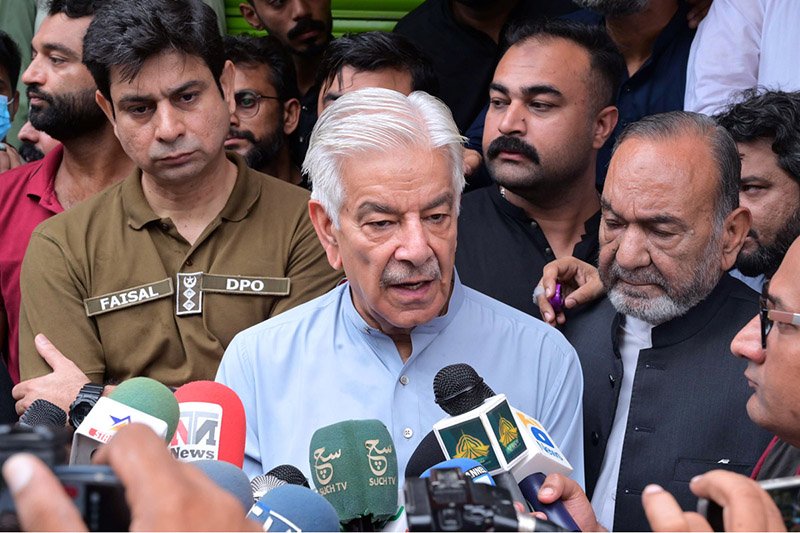
ISLAMABAD — Minister for Defence Khawaja Muhammad Asif has strongly criticized recent remarks made by the Indian Defence Minister regarding the Jammu and Kashmir dispute, labeling them as irresponsible and misleading. Asif’s response comes amid ongoing tensions between the two countries over the region.
What Happened
On July 27, Khawaja Muhammad Asif, Pakistan’s Minister for Defence, addressed comments made by the Indian Defence Minister concerning the Jammu and Kashmir issue. Asif condemned these remarks as an attempt to distort internationally recognized legal realities through political rhetoric and coercive posturing. He articulated his views on the social media platform X, emphasizing that such statements do not alter the status of Indian Illegally Occupied Jammu and Kashmir (IIOJK) nor contribute to regional peace, stability, or meaningful dialogue.
Asif reiterated that Jammu and Kashmir remains an internationally recognized disputed territory, with its final status to be determined in accordance with relevant United Nations Security Council resolutions and the freely expressed will of the Kashmiri people. He criticized India’s repeated attempts to malign Pakistan, arguing that these efforts lack credibility given India’s documented record of state-sponsored terrorism and criminal activities.
The Minister further accused India of being the largest sponsor of terrorism in South Asia, suggesting that its actions hold the region hostage to aggressively revisionist designs. He expressed concern over India’s rhetoric, which he believes risks lowering the threshold for interstate conflict in the region. Despite these challenges, Asif affirmed Pakistan’s commitment to peace and dialogue, while underscoring the country’s resolve to safeguard its sovereignty, territorial integrity, and national security.
Furthermore, Asif suggested that the Indian Defence Minister’s comments were an attempt to deflect attention from internal turmoil and growing unrest against Prime Minister Narendra Modi’s autocratic and divisive governance style.
Background
The Kashmir conflict has been a long-standing issue between India and Pakistan, dating back to the partition of British India in 1947. Both countries claim the region in full but control only parts of it. The dispute has led to several wars and ongoing skirmishes along the Line of Control (LoC), the de facto border in the region.
The United Nations has passed resolutions calling for a plebiscite to allow the Kashmiri people to determine their future; however, this has not been implemented. The region’s status remains a contentious issue, with India revoking the special autonomy of Jammu and Kashmir in August 2019, further escalating tensions.
India’s actions have been met with criticism from Pakistan and various international human rights organizations, which have raised concerns over human rights violations in the region.
Why It Matters
The Kashmir issue is central to the geopolitical dynamics of South Asia, impacting not only the bilateral relations between India and Pakistan but also regional stability and security. The recent exchange of rhetoric between the two countries’ defence ministers highlights the persistent volatility in the region.
For Pakistan, maintaining international attention on the Kashmir issue is crucial to its foreign policy objectives. The country seeks to galvanize international support for a resolution in line with UN resolutions and the aspirations of the Kashmiri people. Asif’s statements serve to reinforce Pakistan’s position and challenge India’s narrative on the international stage.
Economically, the ongoing conflict affects trade and investment in the region. Political instability and the threat of conflict deter potential investors, impacting economic growth and development. Socially, the people of Kashmir continue to face hardships due to the prolonged conflict, with issues such as restricted movement, communication blackouts, and human rights abuses being reported.
Internationally, the situation in Kashmir has implications for global security, particularly given the nuclear capabilities of both India and Pakistan. Any escalation in tensions poses a risk of broader conflict, making it imperative for the international community to engage in diplomatic efforts to facilitate dialogue and peace.
Key Takeaways
- Khawaja Asif condemned the Indian Defence Minister’s remarks on Kashmir as irresponsible and misleading.
- Asif emphasized that Jammu and Kashmir is an internationally recognized disputed territory.
- Pakistan remains committed to peace and dialogue, while safeguarding its sovereignty and security.
- The Kashmir conflict continues to impact regional stability, economic growth, and international security.
- International engagement is crucial to resolving the Kashmir issue and preventing further escalation.
Source Attribution
This article is based on official government statements, press releases, and public communications from relevant authorities.














