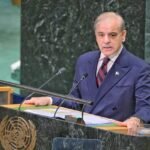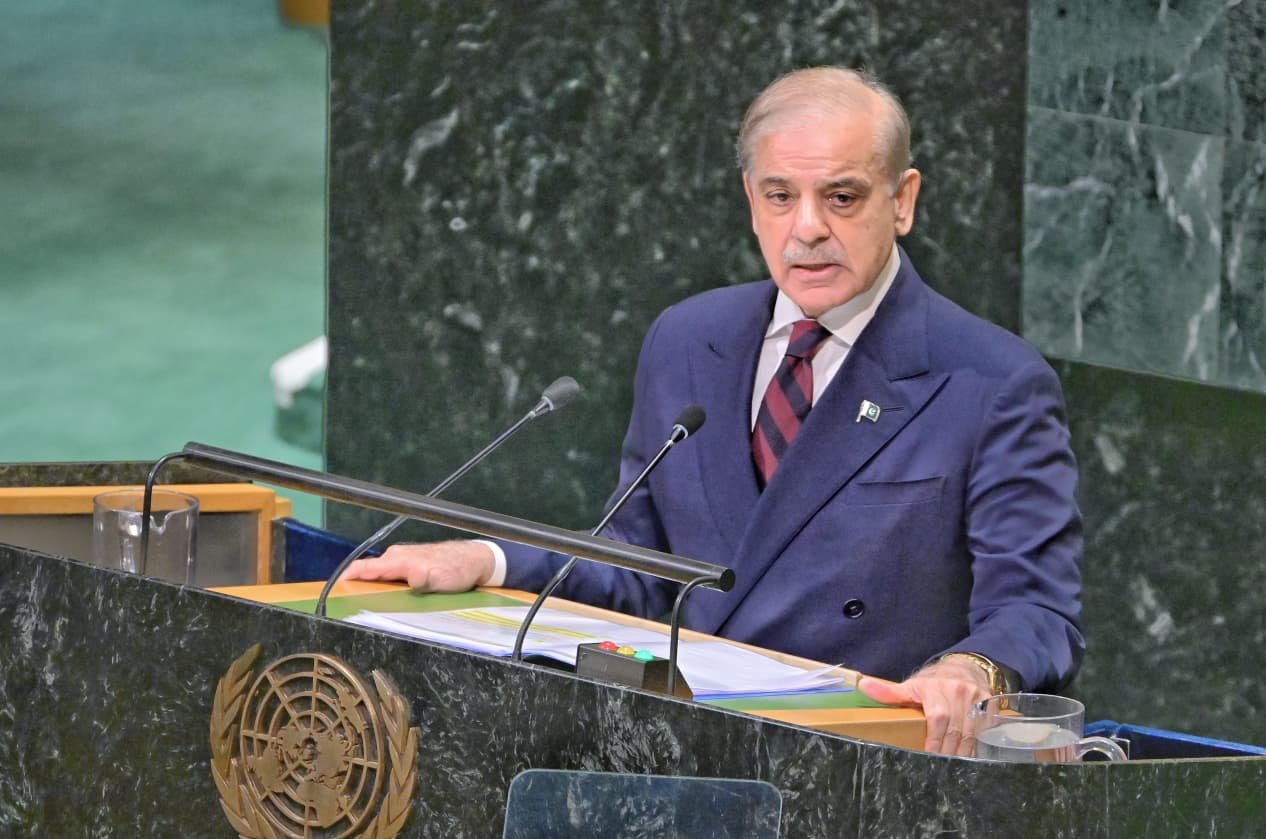
UNITED NATIONS — Prime Minister Shehbaz Sharif affirmed that the Makkah Joint Defence Agreement, involving Saudi Arabia, Türkiye, and Pakistan, is a commitment to regional peace and stability, not a threat to any nation. His remarks came during his address to the United Nations General Assembly on Friday.
What Happened
Prime Minister Shehbaz Sharif addressed the United Nations General Assembly, emphasizing that the Makkah Joint Defence Agreement is a strategic alliance focused on defense, stability, and peace rather than aggression towards any country. The agreement, which unites Saudi Arabia, Türkiye, and Pakistan, is seen as a historic step towards fostering collective security in a volatile region.
During his speech, the Prime Minister condemned recent attacks by the Houthi rebels against Saudi Arabia, particularly an attempted drone assault on the sacred city of Makkah. “The attempted drone attack on the holy city of Makkah Al-Mukarramah has outraged Muslims across the globe,” he stated, underscoring the emotional and religious significance of the site.
Prime Minister Sharif stressed that any threat to the Haramain Sharifain, the two holy mosques in Makkah and Medina, is a ‘red line’ that should not be crossed. He reaffirmed Pakistan’s unwavering support for Saudi Arabia, noting, “Pakistan stands in complete solidarity with the brotherly people of Saudi Arabia, as we always have throughout our history.”
Background
The Makkah Joint Defence Agreement was recently signed among Saudi Arabia, Türkiye, and Pakistan, marking a significant development in regional defense cooperation. This agreement comes amidst ongoing tensions in the Middle East, particularly with the persistent threat posed by Houthi rebels in Yemen, who have frequently targeted Saudi Arabia with missile and drone attacks.
Historically, Pakistan and Saudi Arabia have shared a close relationship, with Pakistan often expressing solidarity with Saudi Arabia on various international platforms. The two countries have cooperated extensively in defense and economic sectors, and the inclusion of Türkiye in this agreement signals a broader coalition aimed at enhancing regional security.
Why It Matters
The Makkah Joint Defence Agreement is pivotal for several reasons. Economically, the stability of the Middle East is crucial for global energy markets, as the region is a major oil supplier. Any disruption could have significant repercussions on global oil prices and economic stability.
Politically, the alliance strengthens the diplomatic ties between Pakistan, Saudi Arabia, and Türkiye, potentially serving as a counterbalance to other regional powers. This cooperation could lead to a more coordinated approach to addressing conflicts and fostering peace in the Middle East.
Socially, the agreement and the Prime Minister’s strong condemnation of attacks on Makkah resonate deeply with the Muslim world. The sanctity of the holy cities is a unifying concern for Muslims globally, and any threat to these sites can provoke widespread outrage and unrest.
Internationally, the agreement signals a shift towards multilateral defense strategies in the region, which could influence other nations’ foreign policies and defense postures. The emphasis on peace and stability could encourage diplomatic solutions to longstanding conflicts.
Key Takeaways
- The Makkah Joint Defence Agreement involves Saudi Arabia, Türkiye, and Pakistan, focusing on regional peace and stability.
- Prime Minister Shehbaz Sharif condemned Houthi attacks on Saudi Arabia, particularly the attempted drone strike on Makkah.
- The agreement is not directed against any specific country but aims to enhance collective security in the Middle East.
- Pakistan reaffirms its solidarity with Saudi Arabia, emphasizing the sanctity of the Haramain Sharifain.
- The alliance could have significant economic, political, and social implications for the region and beyond.
Source Attribution
This article is based on official government statements, press releases, and public communications from relevant authorities.