
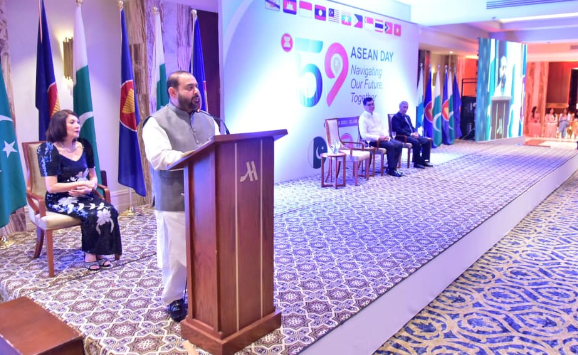
ISLAMABAD — Pakistan is actively pursuing a full dialogue partnership with the Association of Southeast Asian Nations (ASEAN), Federal Minister for Cultural Heritage Aurangzeb Khichi announced on Thursday. The move is part of Pakistan’s broader strategy to enhance trade, investment, and economic cooperation with ASEAN member states.
What Happened
During a ceremony in Islamabad, Minister Aurangzeb Khichi emphasized Pakistan’s commitment to forging stronger ties with ASEAN. He stated, “Pakistan aspires to become a full dialogue partner of ASEAN to unlock new opportunities in trade, investment, and economic cooperation.” This announcement underscores Pakistan’s strategic interest in deepening its engagement with Southeast Asia, a region known for its dynamic economic growth and significant geopolitical influence.
The minister highlighted the potential benefits of such a partnership, including increased market access for Pakistani goods and services, enhanced bilateral trade, and collaboration in various sectors such as technology, education, and cultural exchange. Khichi also pointed out that ASEAN’s collective economic strength presents a valuable opportunity for Pakistan to diversify its trade partners and reduce reliance on traditional markets.
Khichi’s remarks come at a time when Pakistan is seeking to expand its economic horizons and integrate more closely with regional economies. The pursuit of a full dialogue partnership with ASEAN is seen as a strategic move to align with the economic dynamism of Southeast Asia, which is home to some of the world’s fastest-growing economies.
Background
ASEAN, established in 1967, is a regional organization comprising 10 Southeast Asian countries, including Indonesia, Malaysia, the Philippines, Singapore, and Thailand. It aims to promote economic growth, cultural exchange, and political stability in the region. Pakistan has been an ASEAN Sectoral Dialogue Partner since 1993, which allows it to engage with ASEAN on specific issues of mutual interest.
Over the years, Pakistan has sought to elevate its status within ASEAN to a full dialogue partner, a designation that would enable more comprehensive cooperation across a broader range of sectors. Full dialogue partners of ASEAN include countries like China, Japan, and India, which have established extensive economic and strategic ties with the region.
Why It Matters
The pursuit of a full dialogue partnership with ASEAN is significant for Pakistan’s economic and geopolitical strategy. As Pakistan faces economic challenges, including a trade deficit and the need for foreign investment, closer ties with ASEAN could provide a much-needed boost to its economy. The ASEAN region, with a combined GDP of over $3 trillion, offers vast opportunities for trade and investment that could help Pakistan diversify its economic partnerships.
Moreover, a full dialogue partnership with ASEAN would enhance Pakistan’s geopolitical standing in the Asia-Pacific region. It would allow Pakistan to participate more actively in regional discussions on economic and security issues, thereby increasing its influence in a strategically important area. This could also lead to greater collaboration in addressing regional challenges such as climate change, terrorism, and maritime security.
For ASEAN, strengthening ties with Pakistan could provide access to a market of over 220 million people and a gateway to South Asia. It would also support ASEAN’s goal of expanding its partnerships beyond its immediate neighborhood, thereby enhancing its global reach and influence.
Key Takeaways
- Pakistan is seeking a full dialogue partnership with ASEAN to enhance trade and economic cooperation.
- Minister Aurangzeb Khichi emphasized the potential benefits of increased market access and bilateral trade.
- ASEAN is a key regional organization with significant economic and geopolitical influence.
- Closer ties with ASEAN could boost Pakistan’s economy and geopolitical standing.
- The partnership would benefit ASEAN by providing access to Pakistan’s large market and strategic location.
Source Attribution
This article is based on official government statements and public communications from relevant authorities.














