
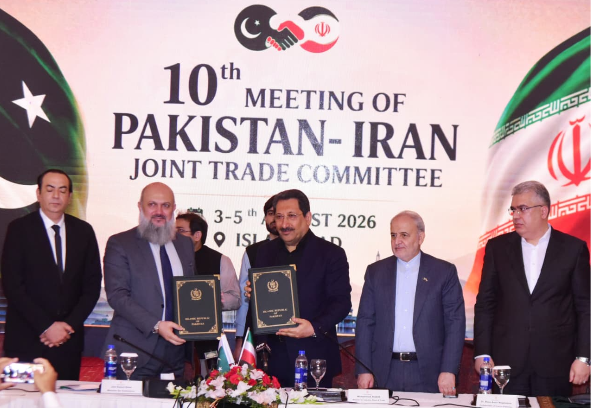
ISLAMABAD — Pakistan and Iran have concluded the 10th Session of the Pakistan-Iran Joint Trade Committee, agreeing on a series of measures aimed at enhancing bilateral trade. The session, held on August 5, was co-chaired by Federal Minister for Commerce Jam Kamal Khan and Iran’s Minister of Industry, Mines, and Trade. Both nations expressed a shared ambition to achieve an annual trade volume of US$ 10 billion.
What Happened
The 10th session of the Pakistan-Iran Joint Trade Committee marked a significant step forward in the economic relations between the two countries. Federal Minister for Commerce Jam Kamal Khan and Iran’s Minister of Industry, Mines, and Trade led the discussions, which focused on enhancing economic cooperation and addressing trade barriers. The meeting concluded with a mutual commitment to increase annual trade to US$ 10 billion, a goal that underscores the strategic importance both countries place on their economic relationship.
During the session, both ministers highlighted the need to remove non-tariff barriers and improve trade facilitation measures. They discussed potential areas for collaboration, including energy, agriculture, and technology transfer. The ministers also agreed to explore joint ventures and investments in sectors of mutual interest, aiming to create a conducive environment for businesses in both countries.
In a joint statement, the ministers emphasized the importance of regular dialogue and exchange of delegations to ensure the effective implementation of agreed measures. They also underscored the need for establishing banking channels to facilitate trade transactions, which has been a longstanding issue due to international sanctions on Iran.
Background
Pakistan and Iran share a long history of cultural and economic ties, with trade being a cornerstone of their bilateral relationship. Historically, trade between the two countries has been affected by geopolitical tensions and international sanctions on Iran. Despite these challenges, both nations have consistently sought to enhance economic cooperation.
The Joint Trade Committee was established as a platform to address trade-related issues and explore opportunities for economic collaboration. Over the years, several sessions have been held, resulting in agreements on various trade facilitation measures. However, the actual trade volume has often fallen short of targets due to logistical and financial barriers.
Why It Matters
The commitment to expand trade ties between Pakistan and Iran holds significant economic and geopolitical implications. Economically, achieving the US$ 10 billion trade target could provide a substantial boost to both economies, particularly in sectors such as energy, agriculture, and technology. For Pakistan, increased trade with Iran could help diversify its trade portfolio and reduce dependency on traditional trading partners.
Geopolitically, strengthening economic ties with Iran aligns with Pakistan’s broader strategy of enhancing regional connectivity and cooperation. It also reflects a pragmatic approach to navigating international sanctions on Iran, as both countries seek to establish mechanisms that facilitate trade while adhering to international regulations.
Furthermore, successful implementation of the agreed measures could serve as a model for other regional trade initiatives, potentially encouraging greater economic integration in South Asia and the Middle East. This could lead to increased stability and prosperity in a region often characterized by political and economic volatility.
Key Takeaways
- Pakistan and Iran have agreed to increase annual bilateral trade to US$ 10 billion.
- The 10th session of the Joint Trade Committee focused on removing trade barriers and facilitating economic cooperation.
- Both countries emphasized the need for establishing banking channels to facilitate trade transactions.
- Strengthening trade ties with Iran aligns with Pakistan’s strategy of enhancing regional connectivity.
- Successful trade expansion could serve as a model for regional economic integration.
Source Attribution
This article is based on official government statements, press releases, and public communications from relevant authorities.














