
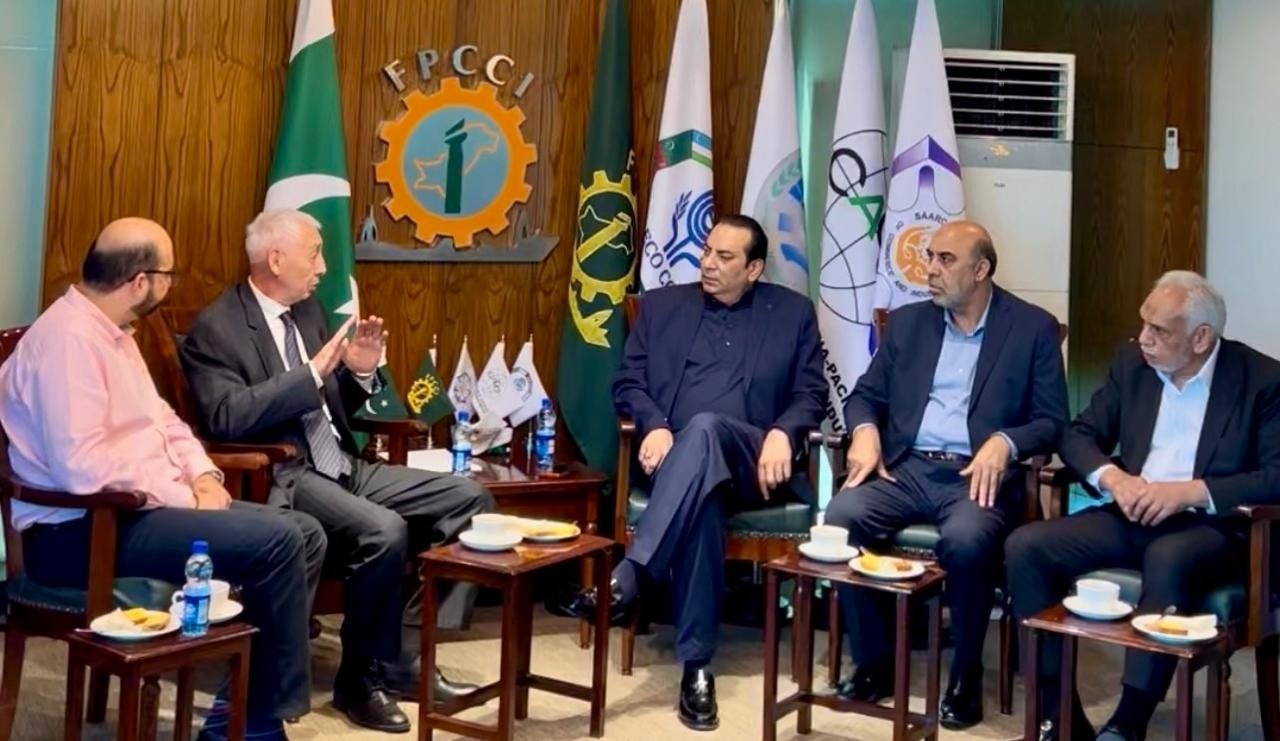
ISLAMABAD — Pakistan and Kyrgyzstan have agreed to establish a Joint Business Council aimed at boosting trade and investment between the two nations. The agreement was reached during a meeting between Aibek Tilebaliev, the Chargé d’Affaires of the Embassy of Kyrgyzstan, and Atif Ikram Sheikh, President of the Federation of Pakistan Chambers of Commerce and Industry (FPCCI), held on Wednesday in Islamabad.
What Happened
The meeting between Aibek Tilebaliev and Atif Ikram Sheikh focused on enhancing bilateral trade, promoting investment opportunities, and strengthening direct business-to-business (B2B) linkages between Pakistan and Kyrgyzstan. Both parties expressed their commitment to fostering economic ties and exploring new avenues for collaboration in various sectors.
According to FPCCI President Atif Ikram Sheikh, the establishment of the Joint Business Council will serve as a platform for regular dialogue and cooperation between the business communities of both countries. He stated, “The council will facilitate the exchange of information, ideas, and experiences, ultimately leading to increased trade and investment flows.”
Aibek Tilebaliev emphasized the potential for growth in trade relations, noting that both countries have complementary economies that can benefit from closer cooperation. He remarked, “Kyrgyzstan is keen to enhance its trade ties with Pakistan, and we see this council as a vital step in achieving that goal.”
The discussions also highlighted the importance of removing trade barriers and simplifying procedures to encourage more robust economic engagement. Both sides agreed to work on identifying specific sectors where mutual benefits could be maximized, including textiles, agriculture, and information technology.
Background
Pakistan and Kyrgyzstan have shared diplomatic relations since Kyrgyzstan gained independence following the dissolution of the Soviet Union in 1991. Over the years, both countries have engaged in various bilateral agreements to enhance cooperation in diverse fields, including education, culture, and trade.
The economic relationship between the two nations has been relatively modest, with trade volumes remaining low compared to their potential. However, recent initiatives, such as the China-Pakistan Economic Corridor (CPEC), have opened new opportunities for regional connectivity, which both countries aim to capitalize on.
The establishment of the Joint Business Council is seen as a strategic move to leverage these opportunities and foster a more dynamic economic partnership.
Why It Matters
The formation of the Joint Business Council between Pakistan and Kyrgyzstan holds significant implications for both countries. Economically, it presents an opportunity to diversify trade portfolios and reduce dependency on traditional markets. By tapping into each other’s strengths, Pakistan and Kyrgyzstan can enhance their economic resilience and competitiveness.
For Pakistan, strengthening ties with Kyrgyzstan aligns with its broader strategy of enhancing regional connectivity and economic integration. The council could facilitate access to Central Asian markets, providing Pakistani businesses with new export destinations and opportunities for joint ventures.
Politically, the initiative reinforces Pakistan’s commitment to fostering peaceful and cooperative relations with its neighbors. It also underscores the importance of economic diplomacy in achieving foreign policy objectives.
On an international level, the collaboration between Pakistan and Kyrgyzstan could serve as a model for other countries in the region, highlighting the benefits of regional cooperation in achieving sustainable economic growth.
Key Takeaways
- Pakistan and Kyrgyzstan have agreed to establish a Joint Business Council to enhance trade and investment.
- The council aims to strengthen B2B linkages and facilitate regular dialogue between the two countries’ business communities.
- The initiative is part of a broader strategy to leverage regional connectivity and economic integration.
- Both countries see potential in sectors like textiles, agriculture, and information technology.
- The collaboration could serve as a model for regional cooperation in Central Asia.
Source Attribution
This article is based on official government statements, press releases, and public communications from relevant authorities.














