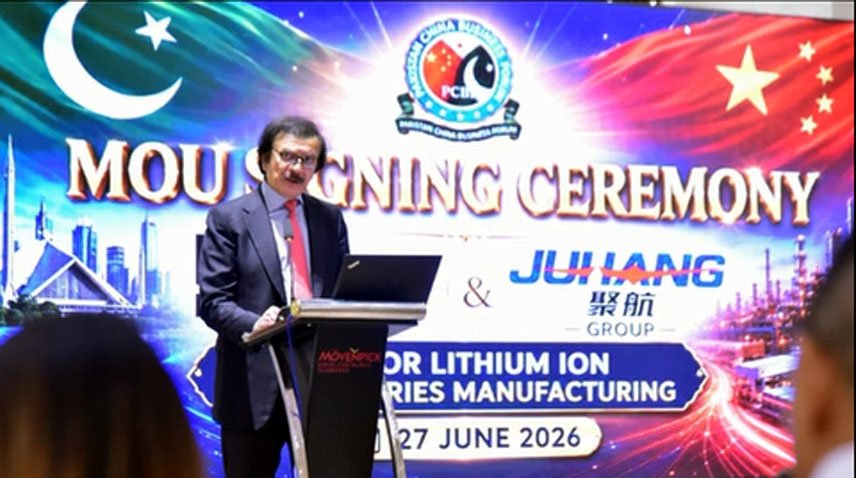
ISLAMABAD — Pakistan and China have signed a transformative Memorandum of Understanding (MoU) to enhance industrial cooperation. This agreement, celebrated at a local hotel on June 28, involves Pakistan’s Saigols Group and China’s Hebei Juhang Energy Technology Group. It focuses on advanced lithium-ion batteries, energy storage systems, and electric vehicle charging infrastructure.
Details of the Agreement
The MoU marks a crucial step in strengthening industrial ties between Pakistan and China. The agreement emphasizes clean energy technologies, particularly lithium-ion batteries and energy storage systems. Haroon Akhtar Khan, Special Assistant to the Prime Minister on Industries and Production, stated that this is not just a commercial deal but a testament to the enduring strength of Pakistan-China cooperation. It promises to boost Pakistan’s industrial future significantly.
Khan highlighted the transition of the Pakistan-China relationship from trust to strategic cooperation. He emphasized China’s leadership in clean energy innovation and expressed Pakistan’s eagerness to advance its industrial sectors by learning from China’s expertise.
This partnership is anticipated to establish a lithium-ion battery assembly and manufacturing facility in Pakistan. It marks the start of a new industrial ecosystem that combines Chinese technological expertise with Pakistan’s entrepreneurial spirit and strategic location.
Historical Context
The Pakistan-China partnership, grounded in mutual trust and strategic interests, has expanded over the years to include infrastructure, energy, and technology. The current MoU builds on earlier agreements, such as the China-Pakistan Economic Corridor (CPEC), a cornerstone of bilateral cooperation.
Pakistan’s industrial policy aims to attract foreign investment and encourage technological advancement through several reforms. The National Industrial Policy and the National Tariff Policy aim to reduce business costs, simplify regulations, and enhance transparency, creating an investor-friendly environment.
Significance for Pakistan
The MoU aligns with the government’s vision for economic transformation under Prime Minister Muhammad Shehbaz Sharif. By focusing on clean energy and advanced manufacturing, it enhances Pakistan’s global competitiveness. Establishing a local lithium-ion battery manufacturing facility reduces import dependency, strengthens the clean energy supply chain, and creates high-value jobs.
This collaboration is timely as the global economy shifts towards green industries and technological innovation. It is expected to stimulate support industries and develop indigenous engineering capabilities. With the rapid adoption of solar energy in Pakistan, reliable energy storage systems become crucial, making this partnership vital for sustainable growth.
Key Points
- The Pakistan-China MoU targets clean energy technologies, particularly lithium-ion batteries.
- The agreement is set to establish a new industrial ecosystem in Pakistan.
- China’s expertise in innovation and clean energy provides valuable insights for Pakistan’s industrial progress.
- The partnership aligns with economic transformation strategies and enhances competitive advantage.