
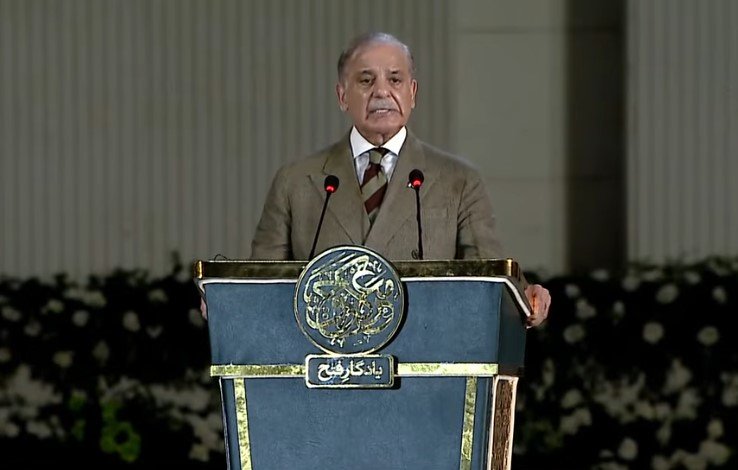
ISLAMABAD — Prime Minister Shehbaz Sharif reaffirmed Pakistan’s commitment to peace while issuing a stern warning of a decisive response to any acts of aggression. Addressing the nation, the Prime Minister emphasized the significance of Pakistan’s water resources, marking them as a critical national interest.
What Happened
Prime Minister Shehbaz Sharif, in a recent public address, underscored Pakistan’s desire for peaceful relations with its neighbors, particularly India. However, he made it unequivocally clear that Pakistan would not hesitate to respond firmly to any threats or aggressive actions. “I declare in clear words that every single drop of Pakistan’s water is our red line,” he stated, highlighting the strategic importance of water resources for the country.
The Prime Minister’s remarks come amid ongoing tensions between Pakistan and India, particularly concerning water rights and territorial disputes. The Indus Waters Treaty, a water-distribution agreement brokered by the World Bank in 1960, has long been a point of contention between the two nations. While the treaty allocates water from the Indus River and its tributaries between the two countries, disagreements over its implementation have led to periodic disputes.
Sharif’s address was a response to recent developments where India has been accused of violating the treaty by constructing dams and diverting water from rivers allocated to Pakistan. The Prime Minister warned that if India does not change its approach, Pakistan will be compelled to take necessary actions to safeguard its interests.
Background
The Indus Waters Treaty has been a cornerstone of India-Pakistan relations, providing a framework for water-sharing between the two countries. Despite its success in preventing major conflicts over water, the treaty has faced challenges, particularly with accusations from Pakistan that India is not adhering to the agreed terms. The construction of dams on rivers such as the Chenab and Jhelum has been a point of contention, with Pakistan fearing reduced water flow into its territory.
Historically, the bilateral relationship between Pakistan and India has been fraught with tension, stemming from territorial disputes and historical conflicts. The situation is further complicated by geopolitical factors and internal political dynamics within each country.
Why It Matters
The Prime Minister’s statement is significant for several reasons. Firstly, it highlights the critical nature of water security for Pakistan, a country that is heavily reliant on agriculture and faces increasing water scarcity. The potential for reduced water flow due to upstream activities by India could have severe implications for Pakistan’s agricultural output and food security.
Secondly, the emphasis on a firm response to aggression underscores the fragile nature of India-Pakistan relations. Any escalation in tensions could have broader regional implications, affecting not only bilateral ties but also regional stability in South Asia. The international community has often expressed concern over the potential for conflict between the two nuclear-armed neighbors.
Finally, the Prime Minister’s remarks reflect an ongoing need for diplomatic engagement and conflict resolution mechanisms to address water disputes and other bilateral issues. Without constructive dialogue, the risk of miscommunication and escalation remains high.
Key Takeaways
- Prime Minister Shehbaz Sharif emphasized Pakistan’s commitment to peace but warned of a firm response to aggression.
- Water security remains a critical issue, with the Indus Waters Treaty being central to Pakistan-India relations.
- The Prime Minister’s remarks highlight ongoing tensions over water rights and territorial disputes.
- Any escalation in tensions could have significant regional implications, affecting stability in South Asia.
- Diplomatic engagement is essential to resolve disputes and prevent conflict between the two countries.
Source Attribution
This article is based on official government statements and public communications from relevant authorities.














