
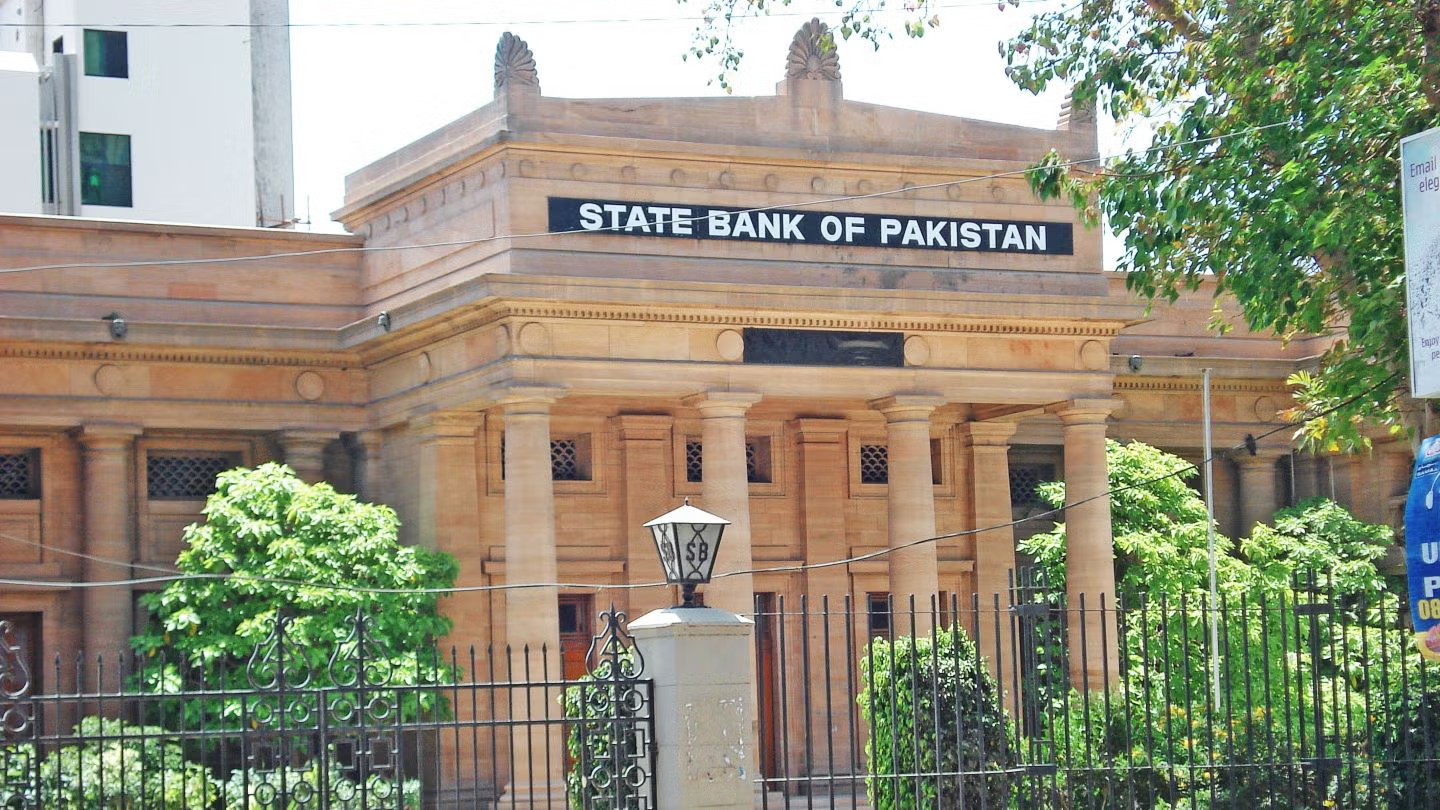
KARACHI — Pakistan’s External Current Account Balance (CAB) recorded a deficit of $139 million during the fiscal year 2025-26, a stark contrast to the surplus of $1,838 million observed in the previous fiscal year 2024-25, according to the State Bank of Pakistan (SBP).
What Happened
The State Bank of Pakistan’s latest report reveals a significant shift in the country’s fiscal health. The CAB, which had shown a surplus in FY25, ended FY26 with a deficit of $139 million. This change is attributed to various factors, including fluctuations in the trade of goods and services.
In June 2026 alone, the CAB recorded a deficit of $649 million, compared to a surplus of $500 million in May 2026 and a surplus of $220 million in June 2025. The trade of goods exhibited a cumulative deficit of $33,623 million for July-June FY26, up from a $26,803 million deficit in FY25. Specifically, June 2026 saw a goods trade deficit of $3,552 million, compared to $3,283 million in May 2026 and $2,429 million in June 2025.
The trade in services showed a deficit of $1,891 million for FY26, an improvement from the $2,836 million deficit recorded in FY25. However, June 2026 saw a services trade surplus of $25 million, a decrease from the $54 million surplus in May 2026, yet an improvement from the $204 million deficit in June 2025.
The overall trade deficit, encompassing both goods and services, reached $35,514 million during FY26, compared to $29,639 million in FY25. In June 2026, the total trade deficit was $3,527 million, compared to $3,229 million in May 2026 and $2,633 million in June 2025.
The Balance on Primary Income recorded a deficit of $8,438 million for FY26, a slight improvement from the $8,838 million deficit in FY25. Meanwhile, workers’ remittances totaled $41,585 million in FY26, up from $38,300 million in FY25. June 2026 saw remittance inflows of $3,475 million, compared to $4,252 million in May 2026 and $3,406 million in June 2025.
The Balance on Secondary Income showed a surplus of $43,813 million for FY26, an increase from the $40,315 million surplus in FY25.
Background
The current account balance is a critical indicator of a country’s economic health, reflecting the difference between a nation’s savings and its investment. Pakistan’s economy has faced numerous challenges in recent years, including fluctuating global oil prices, political instability, and natural disasters, all of which have impacted its trade balance and fiscal policies.
Historically, Pakistan has struggled with maintaining a stable current account balance, often relying on foreign aid and remittances from overseas workers to bolster its economy. The fiscal year 2024-25 was an anomaly with a surplus, largely due to increased remittances and favorable trade conditions.
Why It Matters
The shift from a surplus to a deficit in the current account balance has significant implications for Pakistan’s economy. A deficit indicates that the country is spending more on foreign trade than it is earning, which can lead to increased borrowing and a rise in national debt. This situation can put pressure on the Pakistani rupee, potentially leading to inflation and a decrease in purchasing power for citizens.
The increase in the trade deficit, particularly in goods, suggests that Pakistan is importing more than it is exporting, which can be detrimental to local industries and employment. The improvement in the trade of services and secondary income surplus provides some relief, but the overall economic outlook remains concerning.
For policymakers, these figures underscore the need for strategic economic reforms, focusing on boosting exports, reducing unnecessary imports, and creating a more favorable environment for foreign investment. Additionally, maintaining and enhancing remittance inflows will be crucial in stabilizing the current account balance.
Key Takeaways
- Pakistan’s current account balance recorded a $139 million deficit in FY26, reversing a surplus from FY25.
- The trade deficit in goods increased significantly, contributing to the overall fiscal imbalance.
- Workers’ remittances rose to $41,585 million in FY26, providing some economic support.
- The balance on secondary income showed a surplus, indicating strong inflows from non-trade sources.
- Economic reforms are essential to address the growing trade deficit and stabilize the economy.
Source Attribution
This article is based on official government statements, press releases, and public communications from relevant authorities.














