
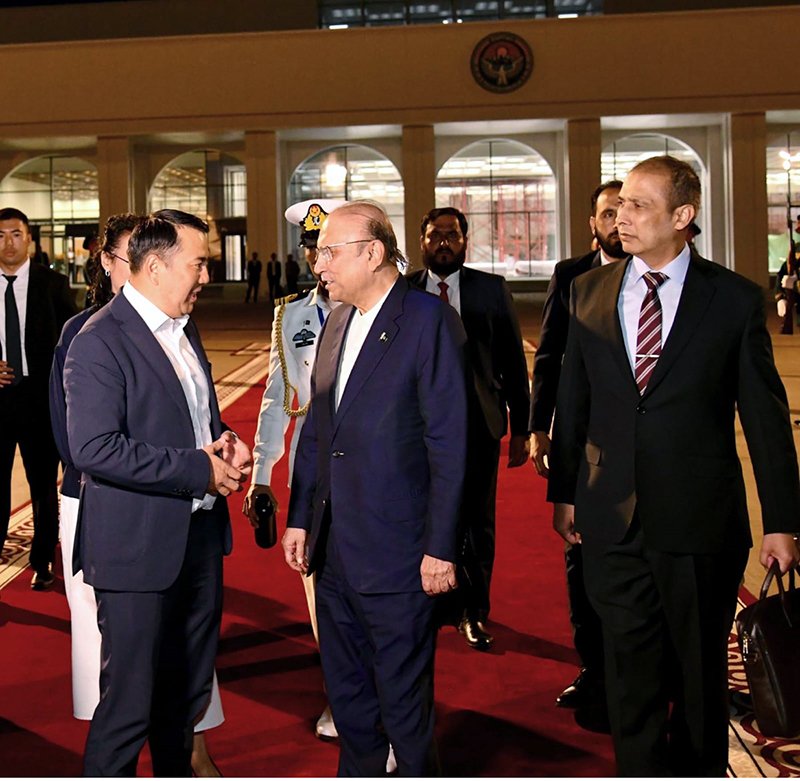
ISLAMABAD — President Asif Ali Zardari departed from Manas International Airport on Tuesday, concluding his official visit to the Kyrgyz Republic. Marlen Mamataliyev, Speaker of the Kyrgyz Parliament, was present to see off the President as he embarked on his journey back to Pakistan.
What Happened
President Asif Ali Zardari’s visit to the Kyrgyz Republic marked a significant diplomatic engagement aimed at enhancing bilateral relations between the two countries. During his stay, President Zardari held discussions with Kyrgyz officials on various matters of mutual interest, including trade, energy cooperation, and regional security. The visit included meetings with Kyrgyz President Sadyr Japarov and other key government officials.
According to official sources, the discussions were fruitful, with both sides expressing a strong commitment to strengthening ties. President Zardari emphasized the importance of regional collaboration, particularly in the fields of trade and energy. He highlighted Pakistan’s interest in participating in regional energy projects, which could benefit both nations economically.
One of the key outcomes of the visit was an agreement to enhance trade relations. The two countries agreed to explore opportunities for increasing bilateral trade volume, which currently stands at a modest level. President Zardari also invited Kyrgyz businesses to invest in Pakistan, offering incentives and assurances of a conducive business environment.
Security cooperation was another critical topic during the discussions. Both countries face common security challenges, and President Zardari reiterated Pakistan’s commitment to working closely with Kyrgyzstan to address these issues. The leaders agreed to enhance intelligence sharing and collaborate on counter-terrorism efforts.
Background
Pakistan and the Kyrgyz Republic have maintained diplomatic relations since the early 1990s, following the dissolution of the Soviet Union. Over the years, both countries have sought to strengthen their ties through various bilateral agreements and high-level visits. The relationship is primarily driven by shared interests in regional stability and economic development.
The Kyrgyz Republic, a landlocked country in Central Asia, has been a focus of Pakistan’s foreign policy due to its strategic location and potential for economic cooperation. In recent years, both nations have participated in regional forums such as the Shanghai Cooperation Organization (SCO) to address common challenges and explore collaborative opportunities.
Why It Matters
The visit of President Zardari to the Kyrgyz Republic holds significant implications for Pakistan’s foreign policy and regional diplomacy. Strengthening ties with Central Asian countries like Kyrgyzstan is crucial for Pakistan’s strategic interests, particularly in terms of energy security and trade diversification.
Central Asia is rich in natural resources, and Pakistan’s engagement with the region can help address its energy needs. By participating in regional energy projects, Pakistan can secure alternative energy sources, reducing its reliance on traditional suppliers. This diversification is vital for ensuring long-term energy security and economic stability.
Moreover, enhancing trade relations with Kyrgyzstan can open new markets for Pakistani goods, contributing to economic growth. The agreement to boost bilateral trade reflects Pakistan’s broader strategy to expand its trade network beyond traditional partners, thereby increasing its economic resilience.
Security cooperation with Kyrgyzstan is also of paramount importance. Both countries face threats from terrorism and extremism, and collaborative efforts can enhance regional stability. By working together on security issues, Pakistan and Kyrgyzstan can contribute to a safer and more secure Central Asia, which aligns with Pakistan’s broader regional security objectives.
Key Takeaways
- President Zardari concluded an official visit to the Kyrgyz Republic, focusing on enhancing bilateral relations.
- The visit included discussions on trade, energy cooperation, and regional security.
- An agreement was reached to increase bilateral trade and explore investment opportunities.
- Security cooperation was emphasized, with commitments to enhance intelligence sharing and counter-terrorism efforts.
- The visit aligns with Pakistan’s strategic interests in Central Asia, particularly in terms of energy security and trade diversification.
Source Attribution
This article is based on official government statements, press releases, and public communications from relevant authorities.














