
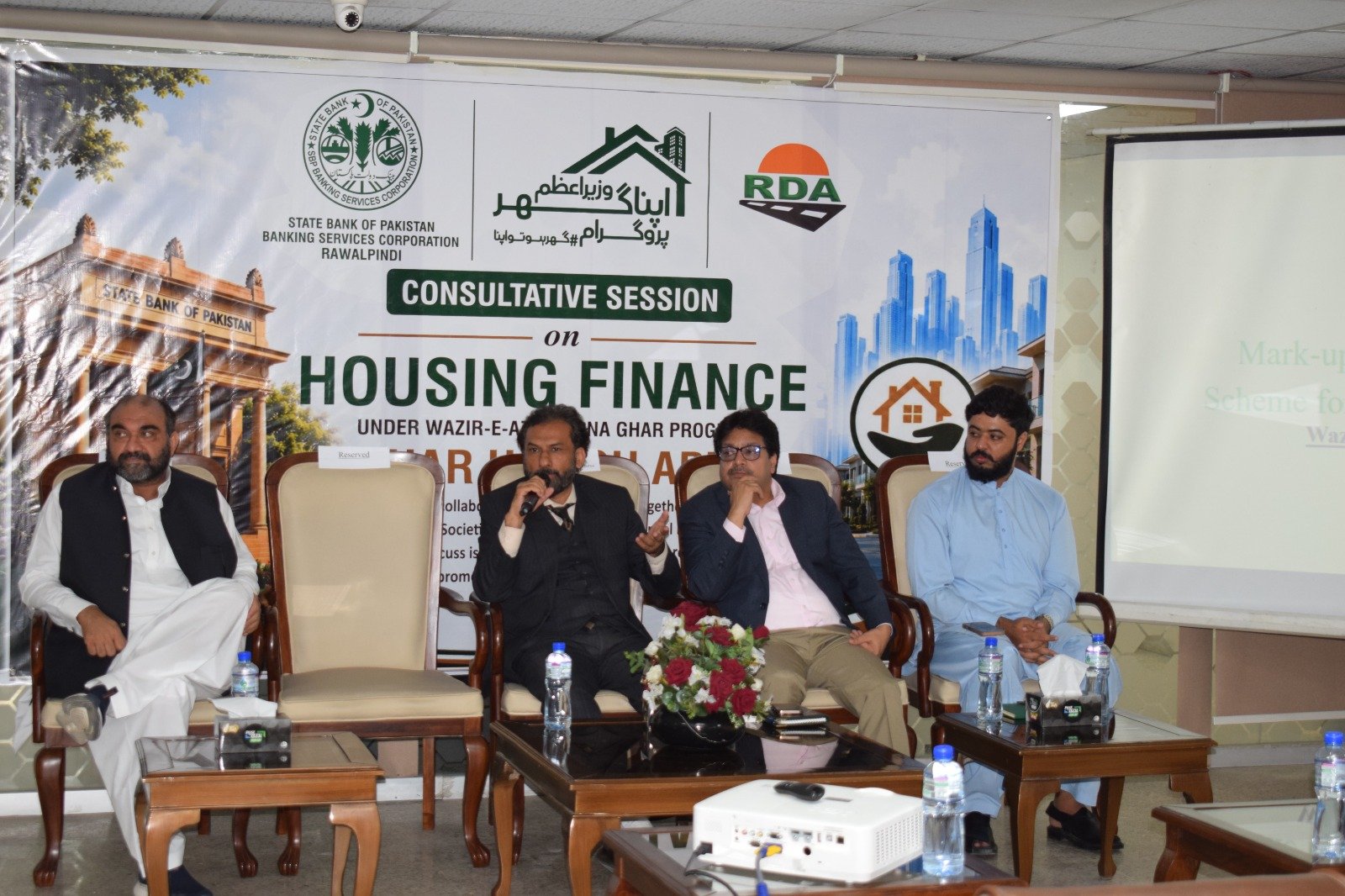
RAWALPINDI — The State Bank of Pakistan hosted a significant consultative session on Thursday to discuss the implementation challenges of the Prime Minister’s Housing Program, known as “Ghar Ho Tou Apna, Apna Ghar Programme.” The event, held in Rawalpindi, gathered representatives from 25 commercial banks, the Rawalpindi Development Authority (RDA), the Rawalpindi Chamber of Commerce and Industry (RCCI), housing societies, students, and the general public.
What Happened
The session, chaired by Rizwan Khaleel Shamsi, Chief Manager of the State Bank Rawalpindi, aimed to address the hurdles faced in executing the housing initiative. Shamsi commended the banks for their active participation in promoting the scheme and urged developers to consider vertical housing as a sustainable and affordable solution. He highlighted the environmental issues resulting from the conversion of forests and green belts into housing societies, advocating for vertical urbanization to mitigate these challenges while providing low-cost housing options.
Shamsi also shared examples of successful low-cost housing models from various countries, suggesting that these could be adapted to fit local needs. During the session, commercial banks presented issues related to documentation, and housing societies received briefings from banks to better inform their customers about the scheme. The banks proposed a one-window operation for documentation at the RDA to streamline the process and recommended appointing focal persons from revenue authorities and the RDA to ensure efficient processing.
The forum included open discussions on mortgage and lien marking issues, with stakeholders sharing challenges and recommendations. Umar Siddique Khattak, Sr. Deputy Chief Manager, announced plans for high-level events and proposed forming a working group with all stakeholders to address challenges and make recommendations for promoting affordable housing in Pakistan. Participants expressed their commitment to making Rawalpindi a model city for low-cost housing and concluded the session by thanking the State Bank for organizing the event.
Background
The Prime Minister’s Housing Program is part of a broader government initiative to address Pakistan’s housing shortage by providing affordable housing solutions. The program aims to facilitate homeownership for low- and middle-income families through various financial incentives and policy measures. The initiative is critical as Pakistan faces a significant housing deficit, exacerbated by rapid urbanization and population growth.
Previous efforts to tackle the housing crisis have included policy reforms and financial packages aimed at encouraging private sector participation and investment in the housing sector. However, challenges such as regulatory bottlenecks, land acquisition issues, and financial constraints have hindered progress.
Why It Matters
The successful implementation of the Prime Minister’s Housing Program is crucial for addressing Pakistan’s housing deficit, which has far-reaching social and economic implications. Access to affordable housing is a fundamental need that impacts quality of life, economic stability, and social equity. By promoting vertical housing, the program aims to provide sustainable solutions that align with environmental conservation goals.
The session’s focus on documentation and process simplification is significant, as bureaucratic hurdles have historically delayed housing projects. Streamlining these processes can accelerate project timelines, reduce costs, and increase accessibility for potential homeowners. Moreover, the formation of a working group comprising key stakeholders indicates a collaborative approach to overcoming challenges, which is essential for the program’s success.
Economically, the housing program has the potential to stimulate growth by creating jobs in construction and related industries. It also encourages financial sector participation, which can lead to increased investment and innovation in housing finance products. Socially, providing affordable housing can enhance community development, reduce urban sprawl, and improve living standards.
Key Takeaways
- The State Bank of Pakistan held a consultative session to address challenges in the Prime Minister’s Housing Program.
- Vertical housing was advocated as a sustainable solution to environmental and housing issues.
- Commercial banks suggested a one-window documentation process at the RDA for efficiency.
- A working group will be formed to address challenges and promote affordable housing.
- The initiative aims to make Rawalpindi a model city for low-cost housing.
Source Attribution
This article is based on official government statements, press releases, and public communications from relevant authorities.














