
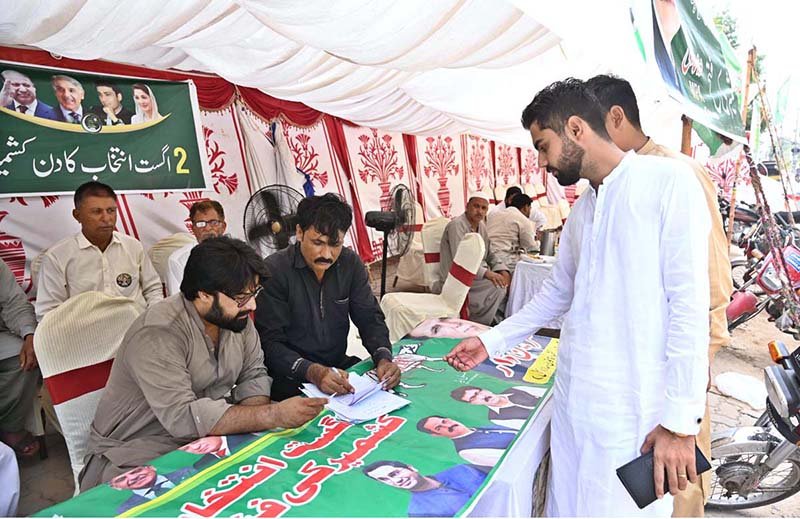
MUZAFFARABAD — Voters in Azad Jammu and Kashmir (AJK) participated in the Legislative Assembly elections, with assistance provided at polling stations to ensure a smooth voting process. The elections took place at various stations, including polling station LA-34, where voters received help at the polling slip counter.
What Happened
The Azad Jammu and Kashmir Legislative Assembly elections witnessed active participation from the electorate, with polling stations set up across the region. At polling station LA-34, voters were seen receiving assistance at the polling slip counter, a crucial step in the voting process to ensure that each voter could cast their vote without any hindrance. Election officials were present to guide voters through the procedures, verifying their identities and issuing polling slips necessary for casting votes.
The polling process was conducted under strict security measures to maintain order and transparency. Voters were required to present valid identification to receive their polling slips, which were then used to access the voting booths. The presence of election officials at the polling slip counters ensured that voters were directed efficiently, minimizing delays and confusion.
In addition to the assistance provided at the polling slip counters, election authorities implemented several measures to facilitate a fair voting process. These included the deployment of security personnel to prevent any untoward incidents and the installation of surveillance systems to monitor activities at the polling stations.
Background
The Legislative Assembly elections in Azad Jammu and Kashmir are a significant democratic exercise, held every five years to elect representatives who will govern the region. The assembly comprises 53 seats, with 45 directly elected by the public and the remaining eight reserved for women, technocrats, and overseas Kashmiris. The elections are conducted under the AJK Election Commission’s supervision, which is responsible for ensuring free and fair elections.
Historically, AJK elections have been a focal point for political parties in Pakistan, with major parties such as the Pakistan People’s Party (PPP), Pakistan Muslim League-Nawaz (PML-N), and Pakistan Tehreek-e-Insaf (PTI) vying for influence in the region. The elections are often seen as a reflection of the political climate in Pakistan and an indicator of public sentiment towards the ruling parties.
Why It Matters
The AJK Legislative Assembly elections hold considerable importance for multiple reasons. Politically, they serve as a barometer for the popularity of political parties within the region and can influence the national political landscape in Pakistan. The results of these elections can impact the power dynamics between the central government and the AJK administration, affecting policy decisions and governance in the region.
Socially, the elections are a vital exercise in democratic participation, allowing the citizens of AJK to voice their opinions and choose their representatives. The provision of assistance at polling stations, such as at LA-34, underscores the commitment to ensuring that every eligible voter can participate in the democratic process without barriers.
Internationally, the AJK elections are closely watched due to the region’s strategic significance and the ongoing Kashmir conflict. Transparent and peaceful elections can enhance the credibility of the democratic process in AJK and contribute to regional stability.
Key Takeaways
- Voters in AJK received assistance at polling stations, ensuring a smooth voting process.
- The elections are a significant democratic exercise, influencing political dynamics in Pakistan.
- Security measures and election official presence were key to maintaining order at polling stations.
- AJK elections are a reflection of public sentiment and have implications for regional stability.
- The process highlights the importance of democratic participation in the region.
Source Attribution
This article is based on official government statements, press releases, and public communications from relevant authorities.














