
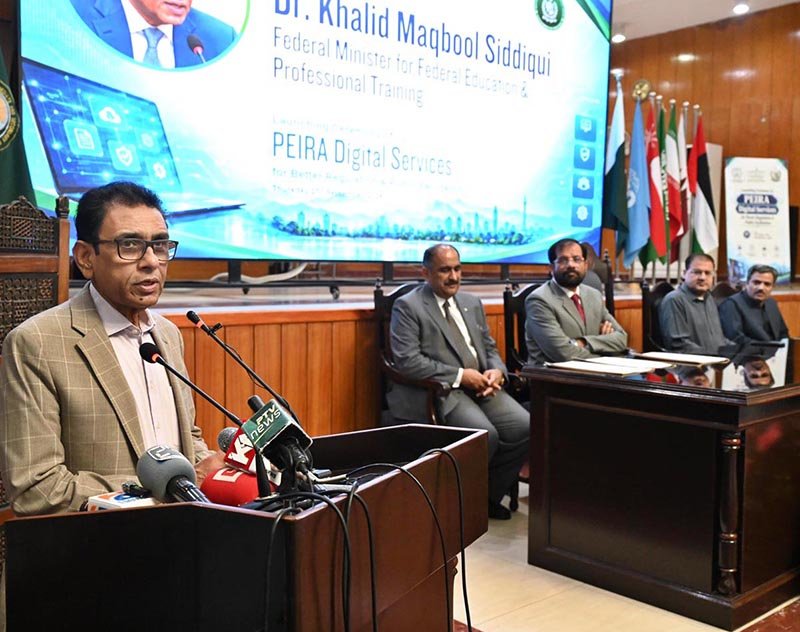
ISLAMABAD — Federal Minister for Education and Professional Training Dr. Khalid Maqbool Siddiqui inaugurated the PEIRA Digital Service: Paperless Regulation & Public Facilitation Initiative on September 17 at the FBISE auditorium. The initiative aims to streamline regulatory processes and enhance public facilitation through digital means.
What Happened
The launch event, held at the Federal Board of Intermediate and Secondary Education (FBISE) auditorium, was attended by government officials, educators, and stakeholders from various sectors. Dr. Khalid Maqbool Siddiqui, the Federal Minister for Education and Professional Training, officially launched the PEIRA Digital Service by pressing a button, marking the beginning of a new era in digital governance for educational institutions.
In his address, Dr. Siddiqui emphasized the importance of adopting digital solutions to improve efficiency and transparency in educational administration. “The PEIRA Digital Service is a significant step towards reducing paperwork and enhancing public facilitation,” he stated. The minister highlighted that this initiative aligns with the government’s broader vision of digital transformation across various sectors.
The PEIRA Digital Service is designed to facilitate the registration, regulation, and monitoring of private educational institutions in Islamabad. By transitioning to a paperless system, the initiative aims to reduce bureaucratic delays and provide a more user-friendly interface for stakeholders. The service will allow institutions to submit applications, receive approvals, and access information online, thereby reducing the dependency on physical documentation.
Background
The Private Educational Institutions Regulatory Authority (PEIRA) has been responsible for regulating private schools and colleges in Islamabad. Historically, the process of registration and compliance involved extensive paperwork, which often led to delays and inefficiencies. The move towards digitalization is part of a broader effort by the government to modernize administrative processes and improve service delivery.
In recent years, the Pakistani government has prioritized digital transformation as a key component of its development strategy. Initiatives such as the Digital Pakistan Vision have been launched to promote technological advancements and integrate digital solutions into various sectors. The education sector, in particular, has been a focus area, with efforts to incorporate technology in teaching, learning, and administration.
Why It Matters
The introduction of the PEIRA Digital Service is a significant development for the education sector in Islamabad. By reducing the reliance on physical paperwork, the initiative is expected to increase efficiency, reduce costs, and minimize the potential for errors in the regulatory process. This will not only benefit educational institutions but also improve the overall experience for students and parents.
Economically, the move towards digitalization can lead to cost savings for both the government and private institutions. By streamlining processes, the government can allocate resources more effectively, while institutions can reduce administrative overheads. This, in turn, could lead to more competitive pricing for educational services, benefiting families and students.
Socially, the initiative promotes transparency and accountability, as digital records are easier to access and audit. This can help build trust between educational institutions and the public, ensuring that regulatory compliance is maintained. Furthermore, the initiative supports the broader goal of increasing digital literacy and familiarity with technology among educators and students.
On an international level, the adoption of digital solutions in education aligns Pakistan with global trends towards e-governance and digital transformation. This can enhance the country’s reputation as a forward-thinking nation committed to leveraging technology for development.
Key Takeaways
- Dr. Khalid Maqbool Siddiqui launched the PEIRA Digital Service in Islamabad.
- The initiative aims to streamline regulatory processes for private educational institutions.
- Digitalization is expected to improve efficiency, reduce costs, and enhance transparency.
- The move aligns with Pakistan’s broader digital transformation goals.
- Economic, social, and international benefits are anticipated from the initiative.
Source Attribution
This article is based on official government statements, press releases, and public communications from relevant authorities.














