
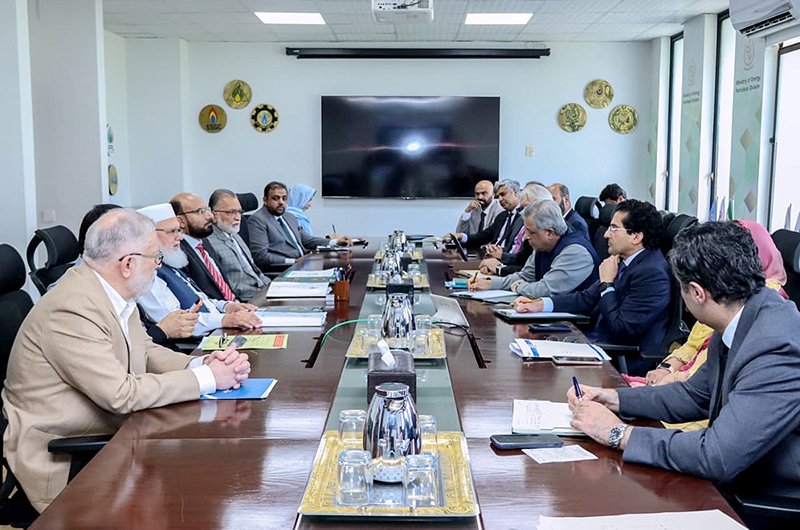
ISLAMABAD — A delegation from Jamaat-e-Islami (JI) held a meeting with Federal Minister for Petroleum Ali Pervaiz Malik, Federal Minister for Law and Justice Azam Nazeer Tarar, and Minister of State for Finance Bilal Azhar Kiani at the Petroleum Division on Monday. The discussions centered around various national issues, including energy policy, legal reforms, and economic challenges facing the nation.
What Happened
The meeting, which took place at the Petroleum Division’s headquarters, was aimed at addressing pressing concerns raised by Jamaat-e-Islami regarding Pakistan’s current socio-economic landscape. The delegation, led by a senior JI official, engaged with the ministers to discuss strategies for improving energy efficiency, enhancing legal frameworks, and stabilizing the nation’s economy.
Federal Minister for Petroleum Ali Pervaiz Malik emphasized the government’s commitment to ensuring energy security and sustainability. He stated, “Our focus is on enhancing domestic energy production to reduce dependency on imports and stabilize prices.” The minister also highlighted ongoing projects aimed at increasing the efficiency of the energy sector.
Meanwhile, Federal Minister for Law and Justice Azam Nazeer Tarar discussed recent legal reforms and the government’s efforts to strengthen the judicial system. He assured the delegation of the government’s dedication to upholding the rule of law and enhancing the legal infrastructure to support economic growth.
Minister of State for Finance Bilal Azhar Kiani addressed economic concerns, outlining the government’s fiscal policies designed to boost economic resilience. He noted, “We are working on comprehensive financial strategies to address inflation and support sustainable economic development.”
Background
Jamaat-e-Islami, a prominent political and religious party in Pakistan, has been actively engaging with government officials to advocate for policies that align with its vision of socio-economic justice and Islamic governance. The party has historically focused on issues such as economic inequality, educational reforms, and energy sustainability.
The meeting comes at a time when Pakistan is grappling with significant economic challenges, including high inflation rates, energy shortages, and a need for legal reforms to support business and investment. The government’s engagement with political parties like Jamaat-e-Islami reflects its broader strategy to build consensus and address these multifaceted challenges.
Why It Matters
The meeting between Jamaat-e-Islami and key federal ministers is significant as it underscores the importance of collaborative governance in addressing Pakistan’s complex challenges. By engaging with political parties, the government seeks to foster a more inclusive approach to policy-making, which is crucial for achieving sustainable development.
Economically, the discussions on energy policy are vital as Pakistan faces a persistent energy crisis that affects industrial productivity and overall economic stability. Enhancing domestic energy production and efficiency can lead to reduced import bills and lower energy costs for consumers, thereby alleviating some of the financial pressures on households and businesses.
On the legal front, reforms are necessary to create a more conducive environment for investment and economic activity. Strengthening the rule of law and judicial infrastructure can enhance investor confidence and attract foreign direct investment, contributing to economic growth.
Politically, the engagement with Jamaat-e-Islami demonstrates the government’s willingness to incorporate diverse perspectives into its policy framework, which can lead to more balanced and effective governance. This approach can also help mitigate political tensions and foster national unity.
Key Takeaways
- Jamaat-e-Islami delegation met with key federal ministers to discuss energy, legal, and economic issues.
- The government emphasized its commitment to energy security and legal reforms to support economic growth.
- The meeting highlights the importance of collaborative governance in addressing Pakistan’s challenges.
- Energy policy discussions are crucial for reducing dependency on imports and stabilizing prices.
- Legal reforms aim to strengthen the judicial system and enhance investor confidence.
Source Attribution
This article is based on official government statements, press releases, and public communications from relevant authorities.














