
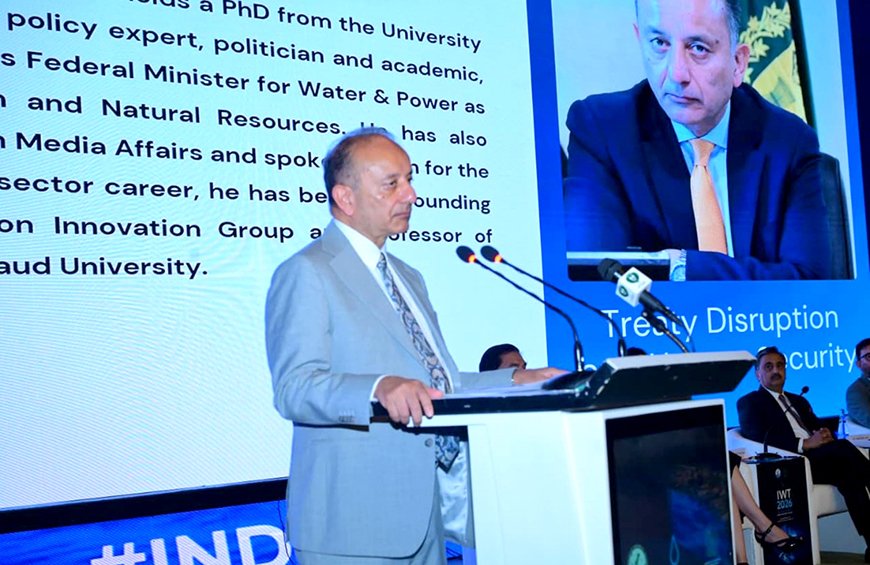
ISLAMABAD — Federal Minister for Climate Change Musadik Masood Malik addressed the International Seminar on the Indus Waters Treaty (IWT) 2026, highlighting the critical importance of water management and cooperation between Pakistan and India. The seminar, held on June 30, was jointly organized by the Ministry of Information & Broadcasting and the Institute of Regional Studies.
What Happened
The seminar saw participation from key political figures and experts who discussed the future of the Indus Waters Treaty, a pivotal agreement between Pakistan and India that governs water distribution from the Indus River system. Musadik Masood Malik, in his address, emphasized the necessity of revisiting and potentially updating the treaty to address contemporary challenges posed by climate change and increasing water scarcity.
Malik stated, “The Indus Waters Treaty has served both nations well for decades, but it is imperative to adapt to the evolving environmental and geopolitical landscape.” He stressed the need for collaborative efforts to ensure sustainable water management and mitigate the impacts of climate change on water resources.
The seminar also featured a keynote address by Deputy Prime Minister and Minister for Foreign Affairs, Senator Mohammad Ishaq Dar, who underscored the treaty’s role in maintaining peace and stability in the region. Additionally, Chairman of the Pakistan People’s Party and former Minister for Foreign Affairs, Bilawal Bhutto Zardari, contributed to the discussions, advocating for enhanced dialogue and cooperation between the two countries.
Background
The Indus Waters Treaty, brokered by the World Bank and signed in 1960, allocates the waters of the Indus River system between Pakistan and India. It has been hailed as a successful example of conflict resolution and cooperation over shared resources. However, the treaty has faced criticism in recent years due to changing climatic conditions and increased demand for water in both countries.
Historically, the treaty has survived various political tensions between the two nations, serving as a buffer against potential conflicts over water resources. Nonetheless, the growing impacts of climate change, such as altered precipitation patterns and glacial melt, have raised concerns about the treaty’s adequacy in addressing future water security challenges.
Why It Matters
The seminar’s discussions are crucial as they highlight the need for a proactive approach to water management in the region. Water scarcity poses significant risks to agriculture, energy production, and overall economic stability in both Pakistan and India. As both nations continue to experience rapid population growth and urbanization, the demand for water is expected to rise sharply, exacerbating existing tensions.
Furthermore, climate change is expected to intensify the frequency and severity of extreme weather events, which could disrupt water availability and distribution. This underscores the importance of revisiting the treaty to incorporate mechanisms that address these emerging challenges and ensure equitable water sharing.
For Pakistan, effective water management is vital for sustaining its agrarian economy, which relies heavily on the Indus River system. The seminar’s outcomes could influence future negotiations and policy decisions, potentially shaping the region’s approach to transboundary water governance.
Key Takeaways
- Musadik Masood Malik emphasized the need to update the Indus Waters Treaty to address climate change and water scarcity.
- The seminar featured key political figures discussing the treaty’s future and its role in regional stability.
- Climate change and increasing water demand pose significant challenges to the treaty’s effectiveness.
- Effective water management is crucial for Pakistan’s economic stability and agricultural sector.
- The seminar’s discussions could influence future policy and negotiations on transboundary water governance.
Source Attribution
This article is based on official government statements, press releases, and public communications from relevant authorities.














