
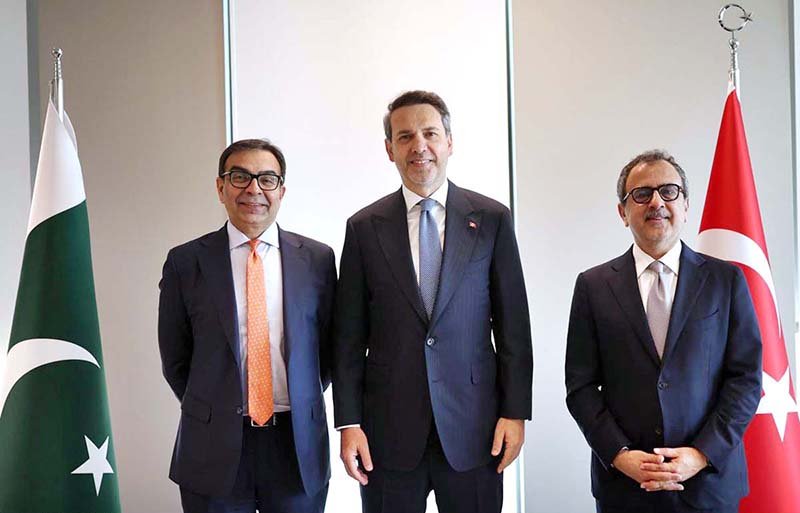
ISTANBUL — On Monday, Muhammad Ali, Adviser to the Prime Minister on Privatisation, and Sardar Awais Ahmad Khan Leghari, Federal Minister for Power, participated in a high-level meeting with Alparslan Bayraktar, Türkiye’s Minister of Energy and Natural Resources. The discussions aimed to boost bilateral cooperation in the vital energy sector.
Meeting Details
The Pakistani delegation, led by Muhammad Ali and Sardar Awais Ahmad Khan Leghari, met with Türkiye’s Energy Minister Alparslan Bayraktar in Istanbul. Their primary aim was to explore opportunities for collaboration in energy production, distribution, and technology exchange. Both parties committed to enhancing ties and sharing expertise in the energy sector.
During the discussions, Minister Leghari emphasized Pakistan’s ongoing efforts to diversify its energy mix and reduce reliance on imported fuels. He stressed the potential in renewable energy projects, particularly in solar and wind, which could benefit from Türkiye’s technological prowess and investment capacity. Leghari stated, “Pakistan is keen to partner with Türkiye in developing sustainable energy solutions to address our growing needs.”
Türkiye’s Perspective
Minister Bayraktar expressed interest in collaboration, highlighting Türkiye’s achievements in renewable energy. “Türkiye has made significant strides in energy efficiency and renewable energy, and we are eager to collaborate with Pakistan to support its energy transition,” he noted.
The meeting concluded with an agreement to establish a joint working group to identify specific projects and initiatives for collaboration. The focus will be on technology transfer, investment opportunities, and policy alignment.
Background of Relations
Pakistan and Türkiye share a history of diplomatic and economic relations, with energy cooperation as a central focus recently. Pakistan’s energy sector faces a growing demand-supply gap and heavy reliance on fossil fuels. The government seeks international partnerships to enhance infrastructure and adopt renewable energy.
Conversely, Türkiye has expanded its renewable energy capacity in wind and solar power, also modernizing its energy grid. This makes Türkiye a valuable partner for Pakistan in achieving energy security.
Significance of the Collaboration
The meeting’s significance lies in its emphasis on international collaboration to address energy challenges. For Pakistan, cooperation with Türkiye could advance renewable energy projects, reduce the carbon footprint, and boost energy security.
Economically, such collaboration could attract foreign investment, creating jobs and economic growth. Technology and expertise sharing can help modernize Pakistan’s energy infrastructure, making it more resilient and sustainable.
Politically, strengthening ties with Türkiye aligns with Pakistan’s strategy to diversify international partnerships. This relationship can model other regional collaborations, promoting stability and cooperation.
Key Takeaways
- Pakistan and Türkiye held a high-level meeting to discuss energy cooperation.
- The discussions focused on renewable energy projects and technology exchange.
- A joint working group will be established to identify specific initiatives.
- Energy cooperation could boost Pakistan’s energy security and economic growth.














