
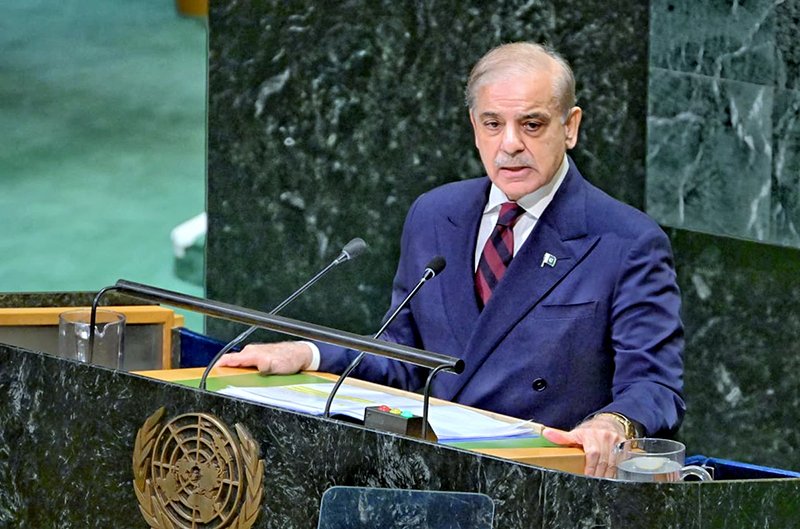
NEW YORK — Prime Minister Muhammad Shehbaz Sharif addressed the 81st session of the United Nations General Assembly on September 25, emphasizing the need for peace in the Middle East and cautioning India against the weaponization of water resources. His speech highlighted Pakistan’s stance on several pressing international issues, including regional stability and resource management.
What Happened
During his address at the United Nations General Assembly, Prime Minister Shehbaz Sharif articulated Pakistan’s concerns regarding regional peace and security. He underscored the importance of resolving conflicts in the Middle East, which have long-lasting implications for global stability. The Prime Minister specifically called for renewed efforts towards peace in the region, urging international stakeholders to engage in dialogue and cooperation.
In his speech, Prime Minister Sharif also addressed the issue of water management, particularly in relation to India. He warned against the potential weaponization of water resources, which could exacerbate tensions between the two nuclear-armed neighbors. He stated, “The weaponization of water is a threat that could have catastrophic consequences for the region and beyond.” This statement reflects Pakistan’s ongoing concerns about water rights and the need for cooperative management of shared resources.
Prime Minister Sharif’s address also touched upon other global challenges, including climate change, economic inequality, and the need for sustainable development. He advocated for collective global action to address these issues, emphasizing that no nation can tackle these challenges alone.
Background
The United Nations General Assembly serves as a platform for world leaders to discuss and address global issues. Pakistan has historically used this forum to highlight its foreign policy priorities and regional concerns. The issue of water management has been a longstanding point of contention between Pakistan and India, with both countries relying heavily on shared river systems.
In recent years, tensions have escalated over water rights, particularly concerning the Indus Water Treaty, which governs the distribution of water from rivers that flow through both countries. The treaty, signed in 1960, has been a critical framework for managing water resources, but disputes have arisen over its implementation and interpretation.
Why It Matters
Prime Minister Sharif’s address at the UN General Assembly is significant for several reasons. Firstly, it highlights Pakistan’s commitment to advocating for peace and stability in the Middle East, a region that has been plagued by conflict for decades. By calling for international cooperation, Pakistan positions itself as a proactive player in seeking diplomatic solutions.
Secondly, the emphasis on the weaponization of water resources underscores a critical issue that affects millions of people in South Asia. Water scarcity and management are becoming increasingly pressing concerns due to climate change and population growth. The potential for conflict over water resources poses a significant threat to regional stability, making it imperative for countries to engage in dialogue and cooperation.
Furthermore, Prime Minister Sharif’s call for global action on climate change and sustainable development aligns with international efforts to address these urgent challenges. By participating in these discussions, Pakistan seeks to contribute to shaping global policies that can lead to a more equitable and sustainable future.
Key Takeaways
- Prime Minister Shehbaz Sharif addressed the UN General Assembly, focusing on Middle East peace and water management.
- He warned against the weaponization of water resources, particularly in relation to India.
- The speech emphasized the need for international cooperation on global challenges like climate change.
- Pakistan’s stance at the UN highlights its role in advocating for regional and global stability.
- The address reflects ongoing concerns about water rights and the Indus Water Treaty.
Source Attribution
This article is based on official government statements, press releases, and public communications from relevant authorities.














