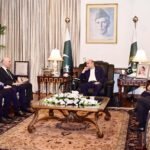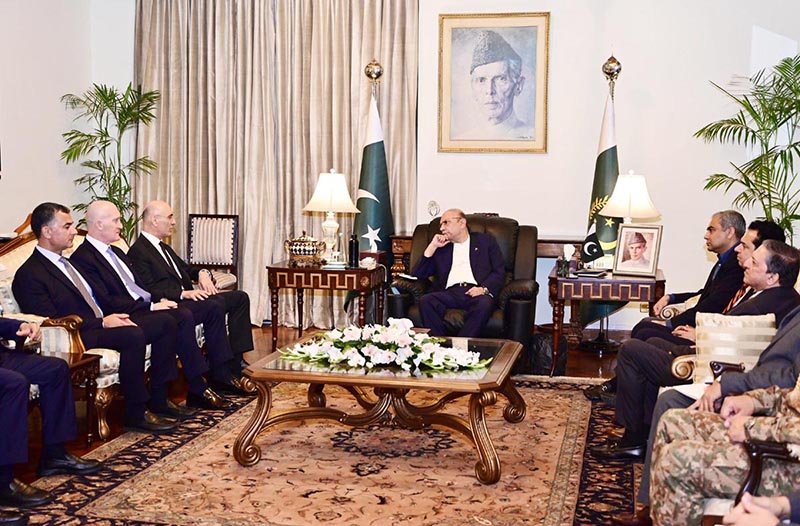
ISLAMABAD — President Asif Ali Zardari held a meeting with Ahmad Al Hajjar, the Minister of Interior and Municipalities of the Lebanese Republic, at Aiwan-e-Sadr on Thursday. The meeting aimed to strengthen bilateral relations and discuss mutual interests between Pakistan and Lebanon.
What Happened
During the meeting at the presidential residence, President Zardari and Minister Ahmad Al Hajjar engaged in discussions focused on enhancing cooperation in areas of mutual interest, including security, trade, and cultural exchange. The dialogue underscored the importance of fostering stronger ties between the two nations, especially in the context of regional stability and economic growth.
According to an official statement, President Zardari emphasized Pakistan’s commitment to deepening its relationship with Lebanon, highlighting the potential for collaboration in various sectors. “Pakistan and Lebanon share a long history of friendship, and we are keen to explore new avenues of cooperation,” President Zardari stated.
Minister Ahmad Al Hajjar reciprocated the sentiments, expressing Lebanon’s interest in learning from Pakistan’s experiences in counter-terrorism and internal security management. He noted, “Lebanon looks forward to enhancing its partnership with Pakistan, particularly in areas that promote peace and security in the region.”
The meeting also included discussions on the exchange of delegations and the possibility of signing new agreements to facilitate increased trade and investment between the two countries. Both leaders agreed on the need for regular high-level exchanges to sustain the momentum of bilateral cooperation.
Background
Pakistan and Lebanon have maintained diplomatic relations since the 1950s, with both countries often supporting each other in international forums. Historically, the relationship has been cordial, with occasional high-level visits and exchanges that have contributed to a steady but modest level of bilateral trade and cooperation.
In recent years, Pakistan has been keen on expanding its diplomatic and economic ties with Middle Eastern countries, including Lebanon, as part of its broader foreign policy strategy. The focus has been on enhancing trade, investment, and cultural exchanges, which are seen as vital for regional stability and economic development.
Why It Matters
The meeting between President Zardari and Minister Ahmad Al Hajjar is significant for several reasons. Firstly, it represents a continuation of Pakistan’s efforts to strengthen its diplomatic relationships in the Middle East, a region of strategic importance due to its geopolitical dynamics and economic potential.
For Pakistan, enhancing ties with Lebanon could open up new avenues for trade and investment, particularly in sectors such as agriculture, technology, and infrastructure development. This could contribute to Pakistan’s economic growth and help diversify its trade portfolio, reducing reliance on traditional markets.
On the political front, closer ties with Lebanon could enhance Pakistan’s influence in regional affairs, allowing it to play a more active role in promoting peace and stability in the Middle East. This aligns with Pakistan’s broader foreign policy objectives, which include fostering regional cooperation and addressing security challenges through diplomatic means.
For Lebanon, the partnership with Pakistan offers an opportunity to benefit from Pakistan’s expertise in areas such as counter-terrorism and internal security, which are critical for Lebanon’s own stability and development. Additionally, increased trade and investment could provide a much-needed boost to Lebanon’s economy, which has faced significant challenges in recent years.
Key Takeaways
- President Asif Ali Zardari met with Lebanese Interior Minister Ahmad Al Hajjar in Islamabad to discuss bilateral relations.
- The meeting focused on enhancing cooperation in security, trade, and cultural exchange.
- Both leaders expressed a commitment to deepening ties and exploring new avenues of collaboration.
- Pakistan and Lebanon have maintained diplomatic relations since the 1950s, with potential for increased trade and investment.
- Strengthening ties with Lebanon aligns with Pakistan’s broader foreign policy objectives in the Middle East.
Source Attribution
This article is based on official government statements and public communications from relevant authorities.