
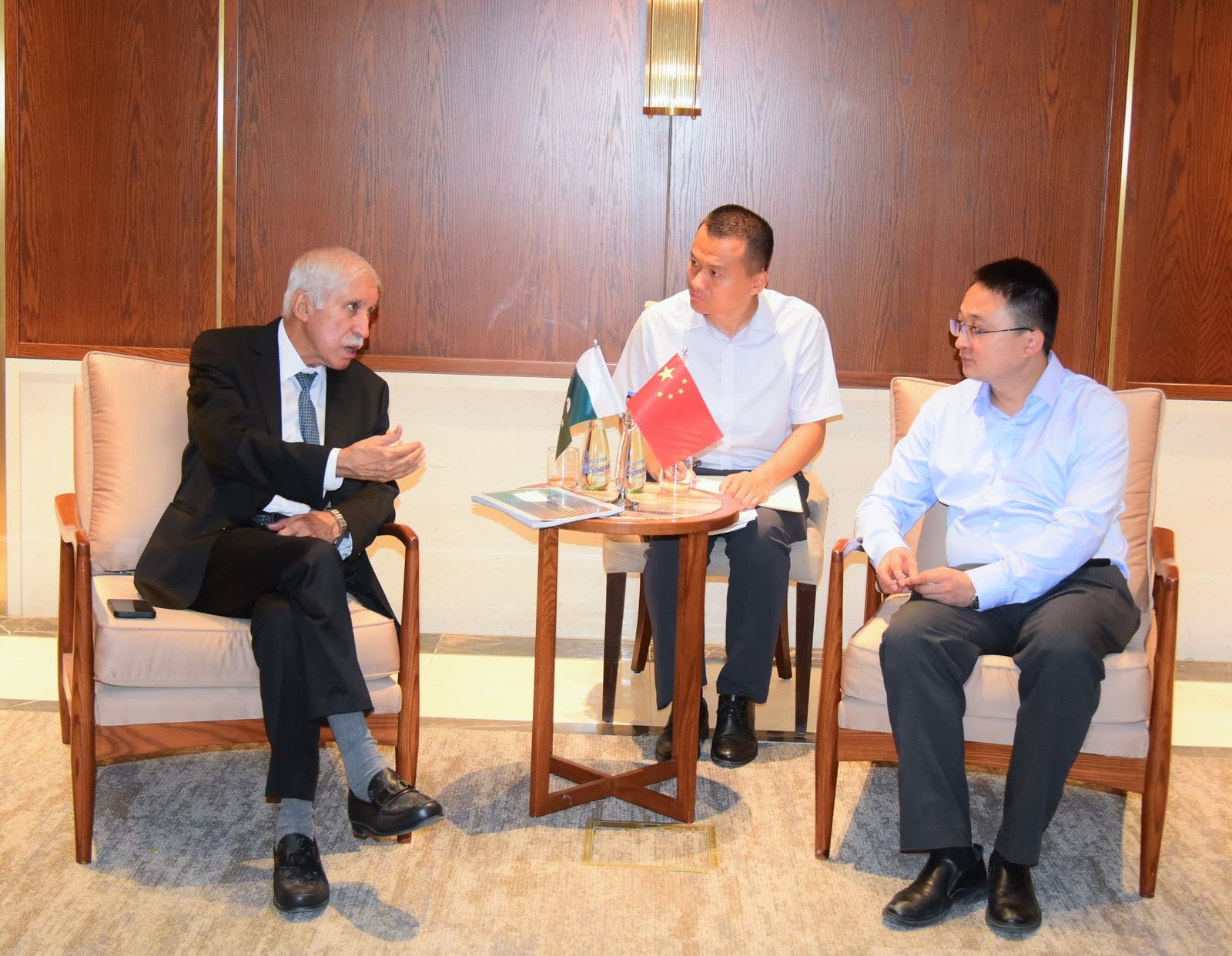
ISLAMABAD — Federal Minister for the Board of Investment (BOI), Qaiser Ahmed Sheikh, convened with a high-level delegation from the Shandong Hi-Speed Group (SDHS) on the sidelines of the Pakistan–China B2B Conference at the Marriott Hotel in Islamabad. The meeting, which took place on Wednesday, aimed to strengthen economic ties and explore investment opportunities between Pakistan and China.
What Happened
The meeting was attended by Mr. Xu Xiang, Chairman of SDHS, along with Mr. Wang Zhenrong, Country Director, and representatives from the Tabani Group. Discussions centered around potential collaborations in infrastructure development and investment projects in Pakistan. The SDHS delegation expressed keen interest in exploring opportunities in Pakistan’s infrastructure sector, particularly in road construction and energy projects.
Minister Qaiser Ahmed Sheikh highlighted Pakistan’s strategic location and its potential as a gateway for Chinese investments into South Asia and the Middle East. He stated, “Pakistan offers a conducive environment for foreign investors with its pro-business policies and strategic partnerships.” The minister also emphasized the government’s commitment to facilitating Chinese businesses and ensuring a seamless investment process.
Mr. Xu Xiang, reflecting on the discussions, noted the promising investment landscape in Pakistan and the mutual benefits of strengthening economic cooperation. He remarked, “We see significant potential in Pakistan’s infrastructure sector and are eager to explore collaborative ventures that can contribute to the country’s economic growth.” The meeting concluded with both parties agreeing to continue dialogue and explore specific projects for potential collaboration.
Background
The Pakistan–China B2B Conference serves as a platform to enhance bilateral trade and investment relations between the two countries. Historically, China has been a significant economic partner for Pakistan, with both nations sharing a robust trade relationship. The China-Pakistan Economic Corridor (CPEC), a flagship project under China’s Belt and Road Initiative, has been pivotal in fostering economic connectivity and development in the region.
The Shandong Hi-Speed Group is a prominent Chinese state-owned enterprise with extensive experience in infrastructure development, including highways, bridges, and energy projects. The group’s interest in Pakistan aligns with the broader objectives of CPEC, aiming to enhance infrastructure and energy capabilities in Pakistan.
Why It Matters
The engagement between the BOI and SDHS is significant for several reasons. Economically, it underscores Pakistan’s ongoing efforts to attract foreign investment and boost its infrastructure sector, which is crucial for economic development and job creation. The potential collaboration with SDHS could lead to substantial investments in infrastructure, enhancing connectivity and supporting Pakistan’s economic growth trajectory.
Socially, improved infrastructure can lead to better access to services, reduced travel times, and enhanced quality of life for citizens. Politically, strengthening ties with China, a longstanding ally, reinforces Pakistan’s strategic partnerships and enhances its geopolitical standing in the region. This meeting also reflects Pakistan’s commitment to leveraging its strategic location to become a hub for regional trade and investment.
Internationally, the collaboration aligns with China’s Belt and Road Initiative, promoting regional connectivity and economic integration. For Pakistan, successful partnerships with Chinese enterprises can attract further international investment, showcasing the country’s potential as a viable investment destination.
Key Takeaways
- BOI Minister Qaiser Ahmed Sheikh met with SDHS to discuss investment opportunities in Pakistan.
- The meeting focused on infrastructure development, particularly in road construction and energy projects.
- Pakistan’s strategic location and pro-business policies were highlighted as advantages for Chinese investors.
- The engagement aligns with the objectives of CPEC and China’s Belt and Road Initiative.
- Strengthening economic ties with China is crucial for Pakistan’s economic growth and regional connectivity.
Source Attribution
This article is based on official government statements, press releases, and public communications from relevant authorities.














