
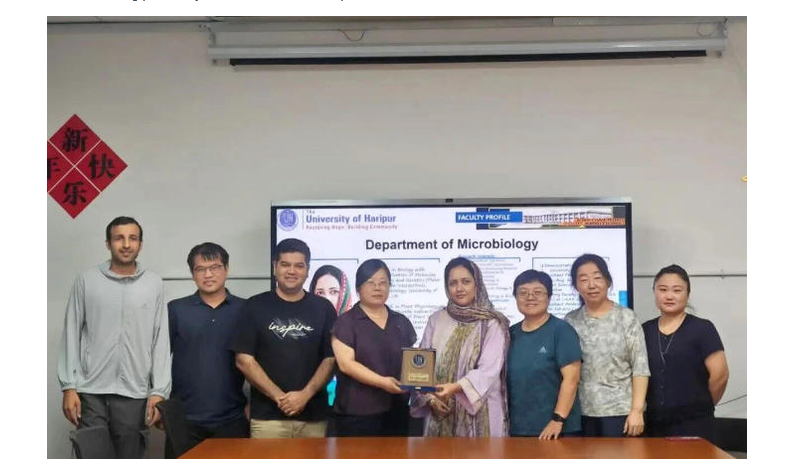
BEIJING — Representatives from Shihezi University’s College of Life Sciences and the University of Haripur recently convened at a symposium focused on microbiomics, revealing plans for joint academic initiatives. The event underscored the deepening academic collaboration between China and Pakistan, particularly in the field of microbial research.
What Happened
The symposium, held in Beijing, brought together experts from both universities to discuss advancements in microbiomics and explore potential areas for joint research. Professor Syeda Asma Bano of the University of Haripur presented her team’s recent breakthroughs in molecular plant pathology, biocontrol, and the use of beneficial microbes to combat soil-borne crop diseases. Her insights were complemented by Professor Sun Yanfei from Shihezi University, who shared findings on plant-microbe interaction mechanisms and the functional analysis of rhizobacteria.
The collaboration aims to leverage the strengths of both institutions in arid-region microbiology and molecular biology. Planned initiatives include the application for joint international research grants, the establishment of joint postgraduate training programs, and the facilitation of academic exchanges. These efforts are intended to foster practical cooperation and advance scientific understanding in these critical areas.
As part of the broader China-Pakistan Economic Corridor (CPEC) initiative, this academic partnership is seen as a reflection of the growing ties between the two nations. Shihezi University has already established extensive partnerships with Pakistani institutions such as the University of Haripur and PMAS-Arid Agriculture University, covering a range of disciplines including life sciences, information technology, agriculture, and basic sciences. These collaborations encompass joint research projects, faculty and student exchanges, joint graduate programs, and the co-construction of laboratories.
Background
The China-Pakistan Economic Corridor (CPEC) is a significant component of China’s Belt and Road Initiative, aimed at enhancing regional connectivity and economic integration. As CPEC enters its second phase, there is an increased focus on socio-economic development, including education and scientific research. The collaboration between Shihezi University and the University of Haripur is part of this broader strategy to enhance academic ties and foster innovation.
Historically, China and Pakistan have maintained strong bilateral relations, with academic and scientific cooperation playing an increasingly important role. The partnership between these universities is a continuation of this trend, aiming to address common challenges in agriculture and environmental sustainability through advanced research and technology.
Why It Matters
The expansion of microbial research cooperation between China and Pakistan holds significant implications for both countries. For Pakistan, advancements in microbiomics and related fields can lead to improved agricultural practices, increased crop yields, and enhanced food security. This is particularly important given the challenges posed by climate change and the need for sustainable agricultural practices.
Economically, the collaboration can open new avenues for research funding and international partnerships, boosting the capabilities of Pakistani institutions and contributing to the country’s scientific and technological development. The joint initiatives also provide opportunities for capacity building, with Pakistani researchers and students gaining access to advanced training and resources.
On a broader scale, the collaboration strengthens the academic and cultural ties between China and Pakistan, fostering mutual understanding and cooperation. This partnership not only contributes to the scientific community but also enhances the strategic relationship between the two nations, supporting their shared goals of regional stability and development.
Key Takeaways
- China and Pakistan are expanding their academic collaboration in microbial research, focusing on microbiomics.
- The partnership includes joint research initiatives, postgraduate training programs, and academic exchanges.
- This collaboration is part of the broader CPEC initiative, emphasizing socio-economic development.
- Advancements in microbial research can significantly impact agriculture and food security in Pakistan.
- The partnership enhances bilateral ties and supports regional stability and development goals.
Source Attribution
This article is based on official government statements, press releases, and public communications from relevant authorities.














