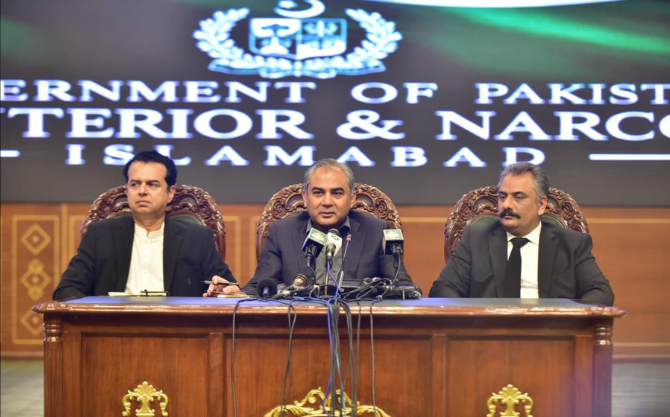
ISLAMABAD — Federal Minister for Interior Mohsin Naqvi has issued a stern warning against any attempts to breach the Islamabad High Court’s (IHC) recent judgment regarding public gatherings in the federal capital. Speaking on September 18, Naqvi emphasized that any violation of the court’s directives would result in immediate legal consequences.
What Happened
Following a detailed judgment by the Islamabad High Court, Federal Minister for Interior Mohsin Naqvi addressed potential threats to public order in Islamabad. The court’s decision, which was not specified in detail, appears to restrict unauthorized gatherings or movements towards the city center. Naqvi underscored the government’s commitment to uphold the court’s ruling, stating that any attempt to storm or advance on the federal capital in groups would be met with strict legal action.
Naqvi’s statement comes in the wake of increasing political tensions and public demonstrations in various parts of the country. He highlighted the government’s zero-tolerance policy towards any activities that could disrupt the peace and stability of Islamabad. “We will not allow any group or individual to challenge the writ of the state by violating the court’s orders,” Naqvi declared, reiterating the government’s resolve to maintain law and order.
The minister’s warning serves as a preemptive measure to deter any planned protests or unauthorized gatherings that may pose a threat to public safety. The specifics of the IHC’s judgment have not been disclosed, but it is understood to be a response to recent political unrest and the potential for mass mobilizations in the capital.
Background
The Islamabad High Court’s ruling is part of a broader legal framework aimed at regulating public gatherings in the capital. Historically, Islamabad has been a focal point for political demonstrations, often leading to clashes between protesters and law enforcement agencies. The government’s approach has been to balance the right to peaceful assembly with the need to maintain public order.
In recent years, the political landscape in Pakistan has been marked by frequent protests and sit-ins, particularly in Islamabad. These events have sometimes escalated into violent confrontations, prompting the judiciary to intervene and set guidelines for public gatherings. The IHC’s latest judgment is seen as an extension of these efforts to prevent chaos and ensure the safety of citizens.
Why It Matters
The enforcement of the IHC’s order is crucial for maintaining stability in Islamabad, a city that houses key government institutions and foreign embassies. Any disruption in the capital could have significant political and diplomatic repercussions, potentially affecting Pakistan’s international relations and internal security.
For citizens, the government’s firm stance on enforcing the court’s order provides a sense of security and reassurance. It reflects a commitment to uphold the rule of law and protect public spaces from becoming arenas of conflict. Economically, ensuring stability in Islamabad is vital for attracting investment and fostering a conducive environment for business activities.
Politically, the government’s response to the IHC’s judgment is indicative of its broader strategy to manage dissent and maintain control over public discourse. By emphasizing the legal consequences of violating the court’s order, the government aims to deter potential agitators and reinforce its authority.
Key Takeaways
- Federal Minister for Interior Mohsin Naqvi has warned of legal action against violations of the IHC’s order.
- The IHC’s judgment restricts unauthorized gatherings in Islamabad to maintain public order.
- Naqvi’s statement aims to deter potential protests and ensure the safety of the capital.
- The enforcement of the order is crucial for political stability and economic security in Islamabad.
- The government’s approach reflects a commitment to uphold the rule of law and prevent chaos.
Source Attribution
This article is based on official government statements, press releases, and public communications from relevant authorities.