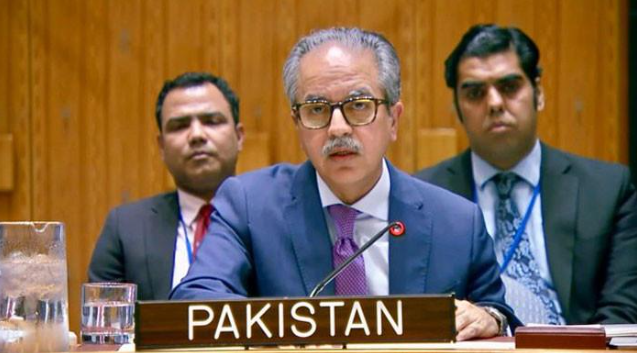
UNITED NATIONS — Pakistan has raised concerns at the United Nations regarding the potential economic consequences stemming from disruptions in key Middle Eastern trade routes. On September 18, a senior Pakistani diplomat emphasized the critical importance of maintaining maritime safety and security, particularly in the Strait of Hormuz and Bab-Al-Mandab, which are vital for global commerce.
What Happened
During a session at the United Nations, Pakistan’s representative underscored the grave implications that disruptions in the Strait of Hormuz and Bab-Al-Mandab could have on international trade. These strategic chokepoints are essential for the transit of oil and goods, and any instability could severely impact global supply chains. The diplomat stated, “It is our principled position that global shipping should not become a casualty of geopolitical tensions.” This statement highlights Pakistan’s stance on the need for uninterrupted maritime trade routes.
The Strait of Hormuz is a narrow passage connecting the Persian Gulf with the Gulf of Oman and the Arabian Sea. It is one of the world’s most significant oil transit chokepoints, with approximately 20% of global petroleum passing through it. Similarly, Bab-Al-Mandab serves as a critical link between the Arabian Sea and the Red Sea, facilitating trade between Europe, Asia, and Africa. Any disruption in these areas could lead to significant economic repercussions globally.
Background
Historically, the Strait of Hormuz and Bab-Al-Mandab have been focal points of geopolitical tensions. The Strait of Hormuz has witnessed numerous incidents, including attacks on oil tankers and military confrontations, primarily due to regional conflicts involving Iran and neighboring Gulf states. Bab-Al-Mandab, situated near Yemen, has also been affected by the ongoing conflict in the region, posing risks to commercial shipping.
International efforts have been made to ensure the safety of these maritime routes. The United Nations and various countries have called for peaceful resolutions to conflicts and have emphasized the importance of maintaining freedom of navigation in these waters. However, the persistent instability in the Middle East continues to pose challenges to these efforts.
Why It Matters
The economic implications of disruptions in the Strait of Hormuz and Bab-Al-Mandab are profound. These chokepoints are not only vital for the transportation of oil but also for the movement of goods, including food and raw materials. Any interruption in these routes could lead to increased shipping costs, delays in delivery, and a rise in global oil prices, affecting economies worldwide.
For Pakistan, a country heavily reliant on imported oil, any increase in oil prices could exacerbate its economic challenges. Higher oil prices would lead to increased costs of goods and services, inflation, and a strain on the national budget. This scenario could have a ripple effect on the country’s economic stability and growth prospects.
Furthermore, the stability of these trade routes is crucial for maintaining global economic balance. Disruptions could lead to economic slowdowns in major economies, impacting international trade and investment. The interconnectedness of global markets means that instability in one region can have far-reaching consequences, affecting countries far removed from the immediate conflict zones.
Key Takeaways
- Pakistan has highlighted the economic risks of disruptions in the Strait of Hormuz and Bab-Al-Mandab at the United Nations.
- These strategic chokepoints are vital for global oil and goods transit, with significant implications for international trade.
- Historical geopolitical tensions in these regions pose ongoing risks to maritime security and global supply chains.
- Disruptions could lead to increased shipping costs, higher oil prices, and economic instability worldwide.
- Pakistan’s economy, reliant on imported oil, could face severe challenges if these trade routes are compromised.
Source Attribution
This article is based on official government statements, press releases, and public communications from relevant authorities.