
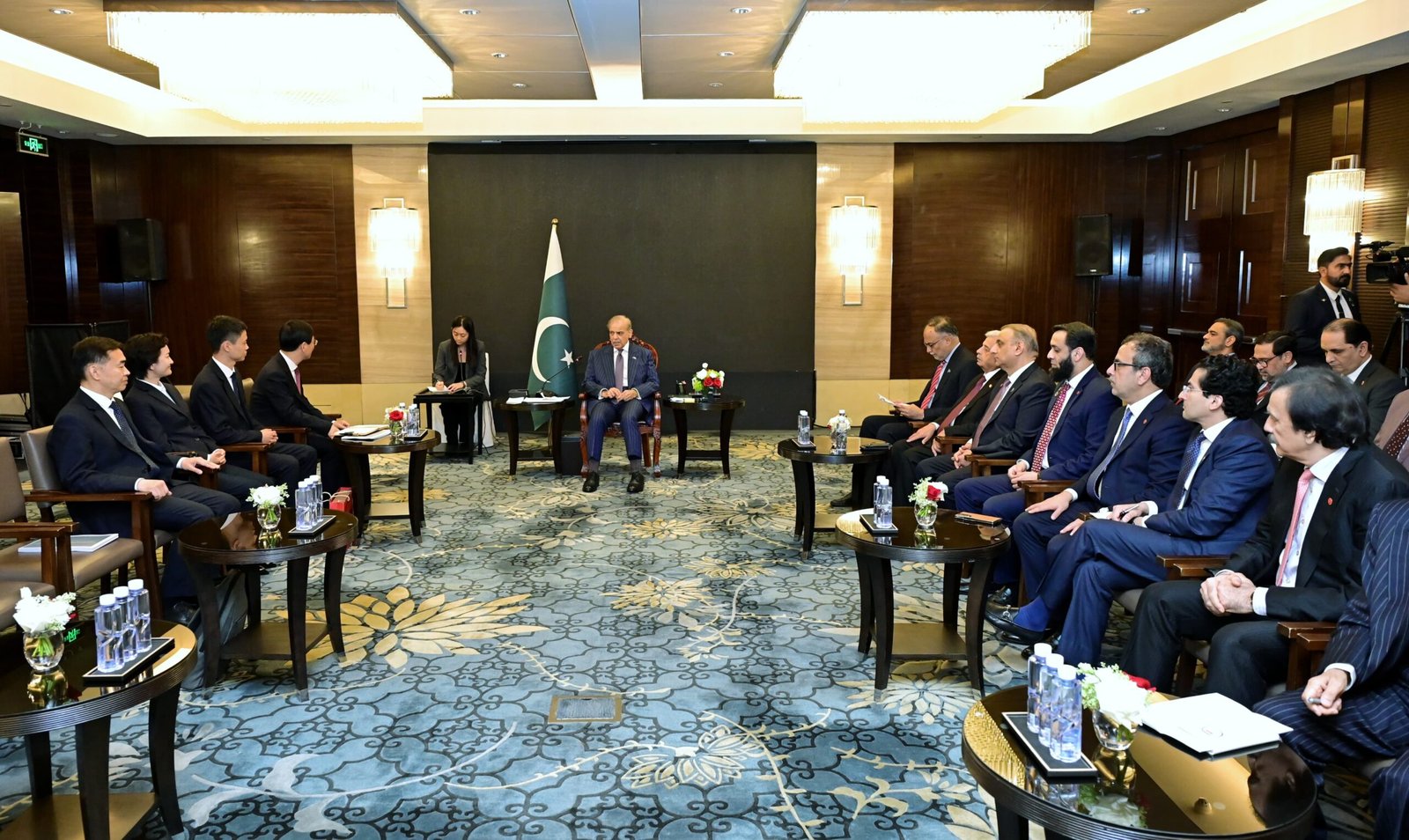
Prime Minister Muhammad Shehbaz Sharif met with top Chinese business leaders in Beijing to discuss economic and infrastructure partnerships as part of the China-Pakistan Economic Corridor (CPEC) Phase II. These discussions aimed to accelerate investment and strengthen bilateral economic ties.
The Prime Minister highlighted key sectors including agriculture, maritime development, mineral resources, and significant infrastructure projects.
FAMSUN’s Role in Agriculture
During a meeting with FAMSUN, led by CEO Mr. Zhengjun Chen, PM Shehbaz emphasized the company’s important role in Pakistan’s agriculture sector. FAMSUN contributes substantially to grain storage, feed production, and food security initiatives.
The Prime Minister urged reducing post-harvest losses and invited FAMSUN to establish manufacturing and technology facilities in Pakistan. Special Economic Zones and the Green Pakistan Initiative offer incentives to enhance productivity and food security.
Shandong Xinxu Group’s Investments
PM Shehbaz met with Chairman Hou Jianxin and representatives from the Shandong Xinxu Group Corporation, commending their growing investments across various sectors in Pakistan.
Investment Focus Areas
- Maritime development initiatives
- Battery manufacturing facilities
- Mineral processing operations
- Industrial cooperation projects
He acknowledged their progress in the Xinxu Special Economic Zone and the Sea-to-Steel project at Port Qasim, assuring full government support to create jobs and boost industrial capacity.
Infrastructure Progress with CCCC
In a separate meeting with Mr. Zhang Bingnan, Chairman of China Communications Construction Corporation (CCCC), and representatives from China Road and Bridge Corporation (CRBC), the Prime Minister expressed appreciation for their ongoing support in Pakistan’s infrastructure growth.
He highlighted projects like the Karakoram Highway and Rashakai Special Economic Zone, focusing on expediting priority initiatives such as the ML-1 railway upgrade and KKH realignment, vital for trade and economic expansion.
Future Economic Cooperation
Chinese business leaders showed confidence in Pakistan’s economic potential, planning to expand investments in agriculture, manufacturing, logistics, infrastructure, and technology sectors.
Accompanied by key Pakistani ministers, the Prime Minister emphasized swift decision-making to advance CPEC Phase II investment, fostering economic growth and generating new revenue streams for both nations.














