
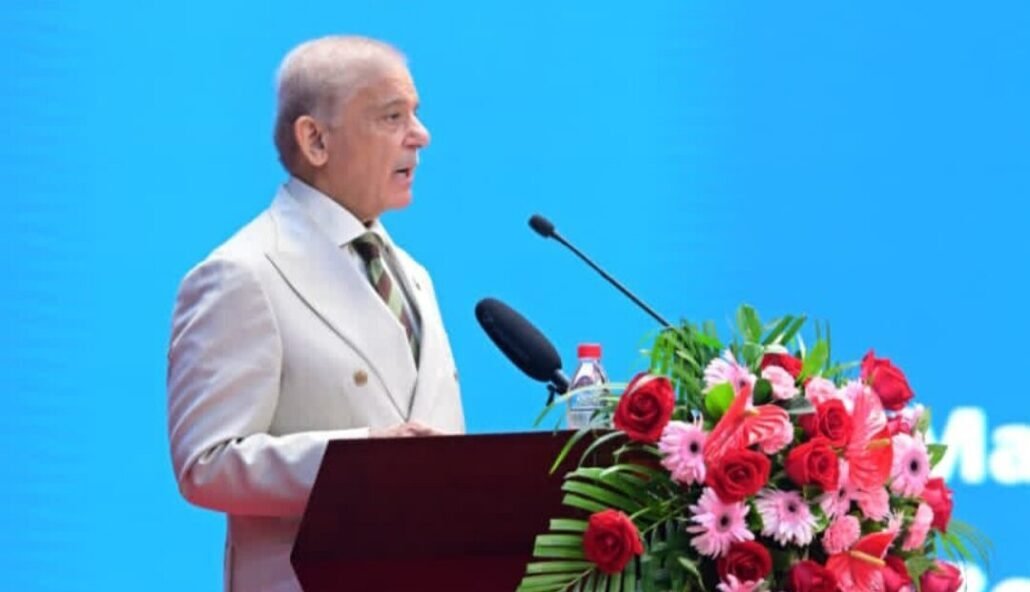
BEIJING: Prime Minister Shehbaz Sharif has called for increased collaboration with China to modernize Pakistan’s agriculture sector. He stressed its vital role in achieving economic self-reliance and national growth.
Pakistan-China Agricultural Workshop
At a high-level workshop on agricultural cooperation at the Chinese Academy of Agricultural Sciences (CAAS) in Beijing, PM Shehbaz urged CAAS to lead efforts in rejuvenating Pakistan’s agricultural research and implementing modern farming practices.
Deepening Strategic Partnership
The Prime Minister underscored the growing strategic economic partnership with China, focusing on agriculture, innovation, and rural development. He expressed gratitude to CAAS President, Professor Dr. Huang Sanwen, after receiving an honorary professorship, recognizing Pakistan’s achievements in these areas.
He remarked, “Celebrating 75 years of diplomatic relations, this milestone inspires us to transform our strong friendship into an economic revolution across agriculture, industry, and research.”
Reviving Agriculture as Economic Backbone
Prime Minister Shehbaz highlighted that agriculture is the backbone of Pakistan’s economy. He advocated adopting modern technology and research to boost productivity and empower the youth. “Looking to Pakistan’s future, we envision farmers facing challenges, scientists in labs, and students learning in premier institutions,” he emphasized.
Revamping PARC
Shehbaz Sharif emphasized rejuvenating the Pakistan Agricultural Research Council (PARC) with CAAS’s guidance. This initiative aims to inject fresh talent and foster a modern research culture in Pakistan’s agricultural institutions.
Training Pakistani Students in China
The Prime Minister announced plans to send 1,000 agriculture graduates annually from all provinces to Chinese universities. These students will learn advanced farming techniques and technologies. “These students represent our country’s future,” he stated, adding that their knowledge will revolutionize agriculture upon their return.
Moreover, plans include inviting these graduates to the Prime Minister’s House to concentrate on practical agricultural reform ideas and innovation.
Agriculture’s Role in CPEC 2.0
In discussions with Chinese President Xi Jinping and Premier Li Qiang, PM Shehbaz noted their agreement to prioritize agriculture in CPEC 2.0, enhancing bilateral cooperation. “I am deeply moved by their assurance of China’s full support for Pakistan’s economic independence,” he said.
He reiterated Pakistan’s commitment to strengthening long-term partnerships among scientists, universities, and researchers from both countries.
Establishing Centres of Excellence
CAAS President, Professor Dr. Huang Sanwen, mentioned that over 300 Pakistani students have already been trained at the academy, laying the groundwork for expanded cooperation. Ahmed Umair, Coordinator to the Prime Minister, underscored the significance of these collaborations.














