
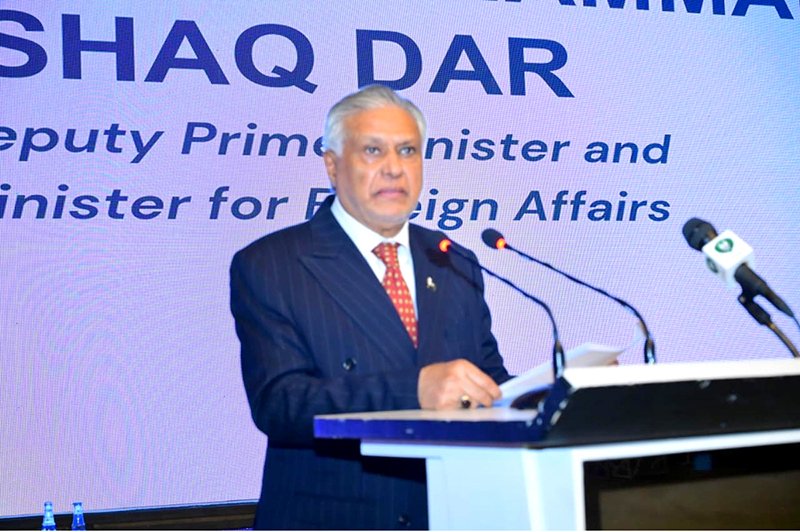
ISLAMABAD — Deputy Prime Minister and Minister for Foreign Affairs, Senator Mohammad Ishaq Dar, delivered the keynote address at the International Seminar on the Indus Waters Treaty (IWT) 2026, held in Islamabad on June 30. The event was jointly organized by the Ministry of Information & Broadcasting (MoIB) and the Institute of Regional Studies (IRS) to discuss the future and implications of the treaty.
What Happened
The seminar, focusing on the Indus Waters Treaty 2026, brought together key government officials, experts, and stakeholders to deliberate on the treaty’s upcoming renegotiation and its impact on regional water management. Senator Mohammad Ishaq Dar, in his keynote address, emphasized the importance of the treaty in maintaining peace and cooperation between Pakistan and India. He stated, “The Indus Waters Treaty is a cornerstone of our bilateral relations with India, and it is imperative that we approach its renegotiation with a spirit of collaboration and mutual benefit.”
The event also featured speeches from other prominent figures, including Federal Minister for Information and Broadcasting, Mr. Attaullah Tarar, who delivered the inaugural address, and Federal Minister for Climate Change, Musadik Masood Malik, who highlighted the environmental implications of the treaty. Discussions at the seminar covered a range of topics, including water resource management, climate change impacts, and the legal frameworks governing transboundary water agreements.
Background
The Indus Waters Treaty, brokered by the World Bank and signed in 1960, is an agreement between India and Pakistan that governs the use of waters from the Indus River and its tributaries. The treaty allocates the waters of three eastern rivers—the Beas, Ravi, and Sutlej—to India, while the waters of the three western rivers—the Indus, Chenab, and Jhelum—are allocated to Pakistan. Despite geopolitical tensions, the treaty has endured for over six decades, serving as a rare example of cooperation between the two nations.
As the treaty approaches its renegotiation phase in 2026, both countries face new challenges, including increased water demand due to population growth, climate change-induced variability in water supply, and the need for sustainable water management practices.
Why It Matters
The renegotiation of the Indus Waters Treaty is of significant importance to both Pakistan and India, as it will shape the future of water resource management in the region. Water scarcity is a growing concern in South Asia, with both countries experiencing increasing demand for water in agriculture, industry, and domestic use. The treaty’s renegotiation offers an opportunity to address these challenges and ensure equitable and sustainable water distribution.
For Pakistan, the treaty is crucial for agricultural productivity and food security, as the Indus River system is the backbone of the country’s irrigation network. Any changes to the treaty’s provisions could have far-reaching implications for Pakistan’s economy and its ability to meet the water needs of its population.
Internationally, the treaty serves as a model for transboundary water cooperation, demonstrating how countries with shared water resources can work together to manage them peacefully. The outcome of the 2026 renegotiation will be closely watched by other nations facing similar challenges, potentially influencing global water diplomacy.
Key Takeaways
- Senator Mohammad Ishaq Dar emphasized the importance of the Indus Waters Treaty for bilateral relations between Pakistan and India.
- The seminar addressed key issues such as water resource management and climate change impacts.
- The Indus Waters Treaty, signed in 1960, is a critical agreement governing water distribution between the two nations.
- Renegotiation of the treaty in 2026 presents opportunities and challenges for sustainable water management.
- The treaty’s outcome will have significant implications for regional and global water diplomacy.
Source Attribution
This article is based on official government statements, press releases, and public communications from relevant authorities.














