
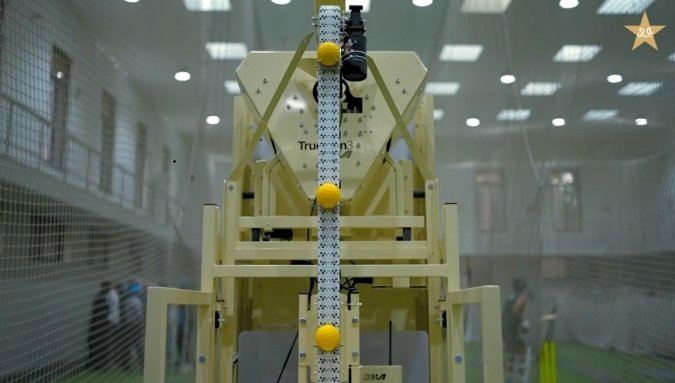
LAHORE — The Pakistan Cricket Board (PCB) has made history by becoming the first cricket board globally to introduce the AI-powered TruMan 3 bowling machine. The unveiling took place on Monday at the National Cricket Academy (NCA) in Lahore, marking a significant advancement in the use of technology for player development.
What Happened
The Pakistan Cricket Board (PCB) on Monday introduced the TruMan 3, an advanced AI-powered bowling machine, at the National Cricket Academy (NCA) in Lahore. This innovative machine is designed to simulate a wide range of bowling styles and conditions, offering players an unprecedented level of training precision. The TruMan 3 utilizes artificial intelligence to mimic the delivery styles of various bowlers, allowing players to practice against different types of deliveries, from fast-paced bouncers to deceptive spin balls.
According to PCB officials, the machine’s AI capabilities will enable it to analyze a batsman’s performance and adjust its deliveries to target specific weaknesses, thereby providing a more tailored and effective training experience. The introduction of the TruMan 3 is part of the PCB’s broader strategy to integrate advanced technology into cricket training and player development programs.
PCB Chairman Zaka Ashraf commented on the unveiling, stating, “The TruMan 3 represents a leap forward in how we prepare our players. By harnessing AI technology, we can offer our athletes a more dynamic and challenging training environment, which is crucial for their growth and success on the international stage.”
Background
The introduction of AI technology in sports is not entirely new, but its application in cricket has been limited until now. The PCB’s decision to adopt the TruMan 3 reflects a growing trend among sports organizations to leverage technology for performance enhancement. Historically, cricket training has relied heavily on human coaches and traditional equipment, but the advent of AI presents new opportunities to refine training methodologies.
In recent years, the PCB has been actively seeking ways to improve its training facilities and methodologies. The National Cricket Academy in Lahore has been at the forefront of these efforts, serving as a hub for innovation and development in Pakistani cricket. The integration of the TruMan 3 into the NCA’s training regimen is expected to set a new standard for cricket training in Pakistan and beyond.
Why It Matters
The introduction of the TruMan 3 AI-powered bowling machine is a significant development for the PCB and Pakistani cricket as a whole. This move underscores the PCB’s commitment to modernizing its training facilities and adopting cutting-edge technology to enhance player performance. By providing players with access to advanced training tools, the PCB aims to improve the competitiveness of Pakistani cricketers on the international stage.
Economically, the adoption of such technology could have far-reaching implications for the PCB. As the first cricket board to implement the TruMan 3, the PCB positions itself as a leader in cricket innovation, potentially attracting sponsorships and partnerships with tech companies. This could lead to increased investment in Pakistani cricket, benefiting players and the sport’s infrastructure.
On a broader scale, the use of AI in cricket training could influence other cricket boards to follow suit, leading to a global shift in how the sport is practiced and played. The PCB’s pioneering step may inspire other nations to explore similar technological advancements, ultimately raising the standard of cricket worldwide.
Key Takeaways
- The PCB has introduced the AI-powered TruMan 3 bowling machine at the NCA in Lahore.
- This makes the PCB the first cricket board in the world to adopt this technology.
- The TruMan 3 uses AI to simulate various bowling styles and tailor training to individual players.
- The move is part of the PCB’s strategy to modernize cricket training and enhance player performance.
- The adoption of AI technology could attract new investments and partnerships for the PCB.
Source Attribution
This article is based on official statements from the Pakistan Cricket Board and public communications from relevant authorities.














