
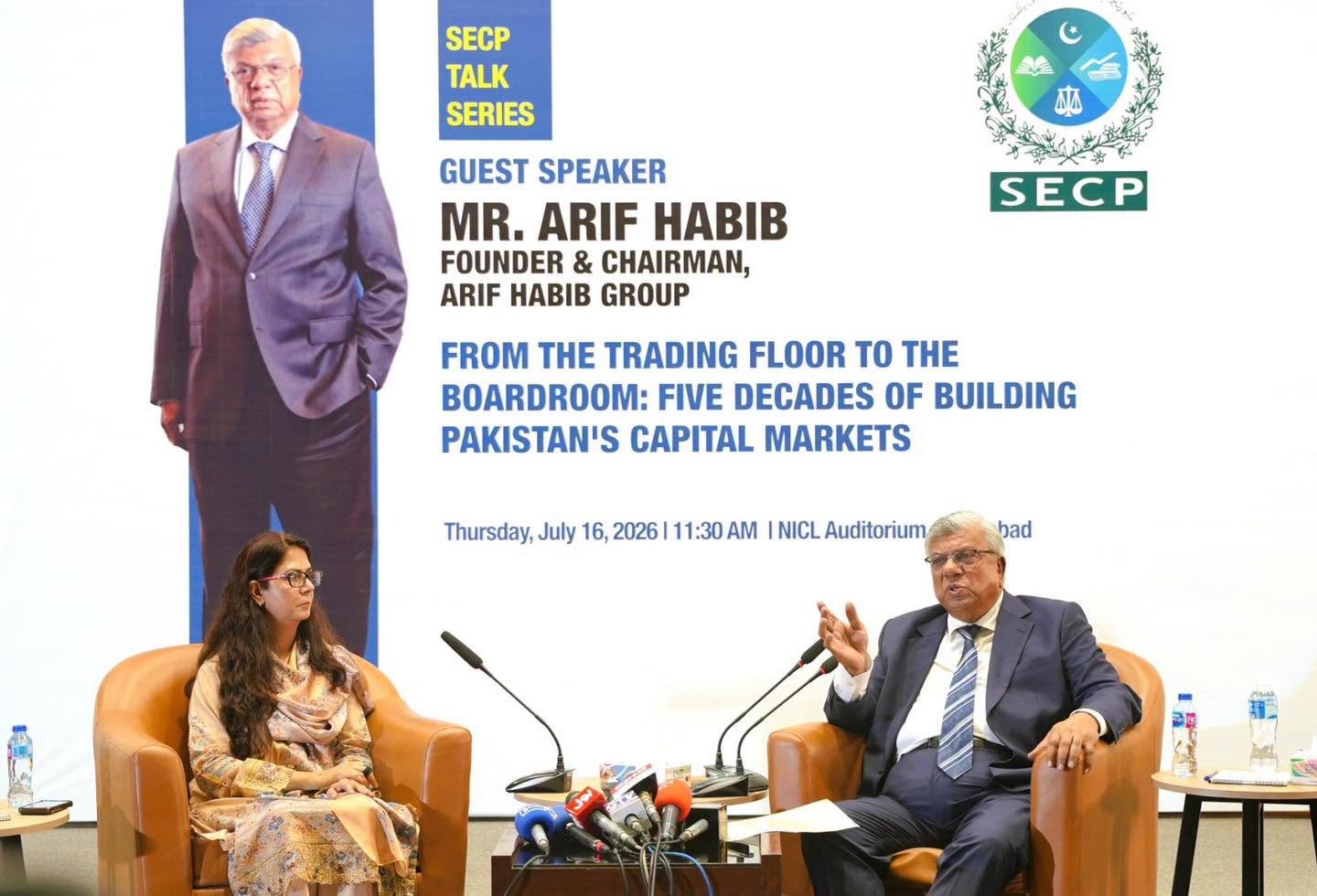
ISLAMABAD — A developed capital market is crucial for sustainable economic growth, veteran businessman Arif Habib emphasized during the Securities and Exchange Commission of Pakistan (SECP) Talk Series held in Islamabad. The event, which took place on July 16, brought together key figures from Pakistan’s financial sector to discuss the evolution and future of the country’s capital markets.
What Happened
At the SECP Talk Series, Arif Habib, a prominent figure with over five decades of experience in Pakistan’s capital markets, highlighted the indispensable role of a developed capital market in fostering sustainable economic growth. The session was attended by SECP Chairman Dr. Kabir Ahmed Sidhu, commissioners, market institutions, academia, and business leaders. The discussions centered on the evolution of Pakistan’s capital markets, the importance of long-term investing, and the necessary reforms to enhance investor participation.
Dr. Kabir Ahmed Sidhu opened the session by underscoring the SECP’s commitment to institutionalizing knowledge-sharing. He stated, “Our objective is to build a capital market ecosystem that is transparent, accessible, and aligned with global standards.” He also outlined ongoing reforms, such as digital investor onboarding, the implementation of the T+1 settlement cycle, and initiatives aimed at expanding the investor base to 2.5 million through greater financial inclusion and easier market access.
Reflecting on the historical journey of Pakistan’s capital markets, Arif Habib traced its development from open-outcry trading floors to the current technology-driven marketplace. He emphasized that despite the evolution of markets, the core principles of successful investing remain discipline, patience, and long-term thinking. Habib pointed out that the Pakistan Stock Exchange has delivered an average annual return of approximately 22 percent over the past 22 years and a 14 percent dollar-denominated return over the last five years.
He stressed the temporary nature of market volatility, advocating for long-term investment in fundamentally strong companies as a means to create sustainable wealth. Habib also highlighted the critical role of capital markets in mobilizing savings, financing businesses, strengthening corporate governance, and generating employment across various sectors, including brokerage, asset management, investment banking, research, fintech, and advisory services.
Furthermore, Habib emphasized the need to increase financial literacy, particularly among young Pakistanis, to broaden participation in formal capital markets.
Background
Pakistan’s capital market has undergone significant transformation over the decades. The SECP, established in 1997, has been instrumental in regulating and developing the capital markets. The Pakistan Stock Exchange (PSX), which was formed by the merger of the Karachi, Lahore, and Islamabad stock exchanges, serves as the country’s primary stock exchange. The PSX has played a pivotal role in facilitating capital formation and investment opportunities.
In recent years, the SECP has introduced various reforms to enhance market efficiency and investor protection. These include the introduction of a T+2 settlement cycle, the establishment of a central depository system, and the implementation of a comprehensive risk management framework.
Why It Matters
The development of a robust capital market is vital for Pakistan’s economic growth and stability. A well-functioning capital market provides businesses with access to capital, enabling them to expand operations, invest in innovation, and create jobs. For individual investors, it offers opportunities for wealth creation and financial security.
In the context of Pakistan’s economy, which faces challenges such as fiscal deficits, inflation, and external debt, a developed capital market can play a crucial role in mobilizing domestic savings and attracting foreign investment. By facilitating efficient allocation of resources, the capital market can contribute to economic diversification and resilience.
Moreover, increasing financial literacy and broadening investor participation are essential for enhancing market depth and liquidity. This, in turn, can lead to more stable and efficient markets, reducing the impact of speculative trading and market volatility.
Key Takeaways
- Arif Habib emphasized the importance of a developed capital market for sustainable economic growth at the SECP Talk Series.
- The SECP is implementing reforms to enhance market transparency, accessibility, and investor participation.
- Pakistan’s capital market has evolved significantly, with the PSX delivering strong returns over the years.
- Increasing financial literacy among young Pakistanis is crucial for broadening market participation.
- A robust capital market can help address economic challenges and attract investment.
Source Attribution
This article is based on official government statements, press releases, and public communications from relevant authorities.














