
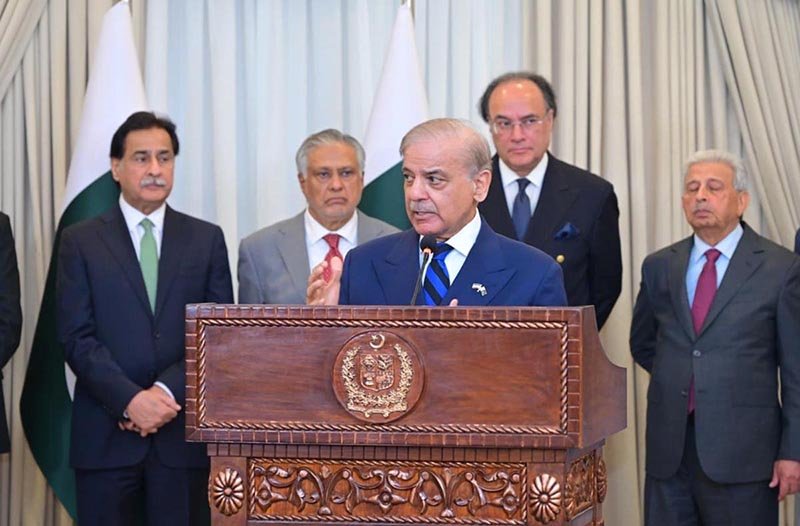
ISLAMABAD — The President of the Islamic Republic of Iran, Dr. Masoud Pezeshkian, and the Prime Minister of the Islamic Republic of Pakistan, Muhammad Shehbaz Sharif, held a joint press conference on Tuesday to discuss bilateral relations and regional cooperation. The meeting in Islamabad highlighted both nations’ commitment to strengthening ties amid evolving geopolitical dynamics.
Key Issues Discussed
During the press conference, President Pezeshkian and Prime Minister Sharif addressed key issues, including economic collaboration, security concerns, and cultural exchanges. They stressed the importance of enhancing trade and investment, focusing on energy cooperation and infrastructure development.
Economic and Energy Cooperation
Prime Minister Sharif stated, “Our discussions today have been fruitful, and we are committed to expanding our economic partnership.” He noted that both nations are eager to explore new avenues for mutual benefit, having a long history of cooperation.
President Pezeshkian echoed these sentiments, emphasizing Iran’s interest in working on projects that bring prosperity to both peoples. He highlighted potential collaboration in the energy sector, especially in developing cross-border gas pipelines.
Regional Security Concerns
The leaders discussed regional security, focusing on the situation in Afghanistan. Both countries, sharing a border with Afghanistan, have an interest in promoting regional stability and peace. They agreed to enhance intelligence sharing and cooperate closely to address common security challenges.
Background of Iran-Pakistan Relations
Pakistan and Iran have historically maintained cordial relations, based on cultural and religious ties. They have collaborated on trade, energy, and security fronts, despite geopolitical tensions and sanctions on Iran posing challenges at times.
The Iran-Pakistan gas pipeline, known as the “Peace Pipeline,” aims to address Pakistan’s energy needs but has faced political and financial hurdles. Despite this, both continue to express a commitment to the project’s completion.
Significance of the Meeting
This conference signifies a renewed commitment to strengthening Iran-Pakistan ties, crucial amid shifting alliances and the changing geopolitical scene. Enhanced cooperation could lead to significant economic benefits, such as increased trade and investment opportunities.
For Pakistan, collaboration with Iran is essential for alleviating energy shortages. The Iran-Pakistan gas pipeline’s successful implementation could provide a stable energy source, lessening power shortages.
On the security front, both nations face common challenges, especially regarding Afghanistan, and can promote regional stability and counter extremism by working together.
- Iranian President and Pakistani Prime Minister held a joint press conference in Islamabad.
- Discussions focused on economic collaboration, security, and cultural exchanges.
- Leaders emphasized the importance of the Iran-Pakistan gas pipeline project.
- Regional security, particularly in Afghanistan, was a key topic of discussion.














